 Go Back

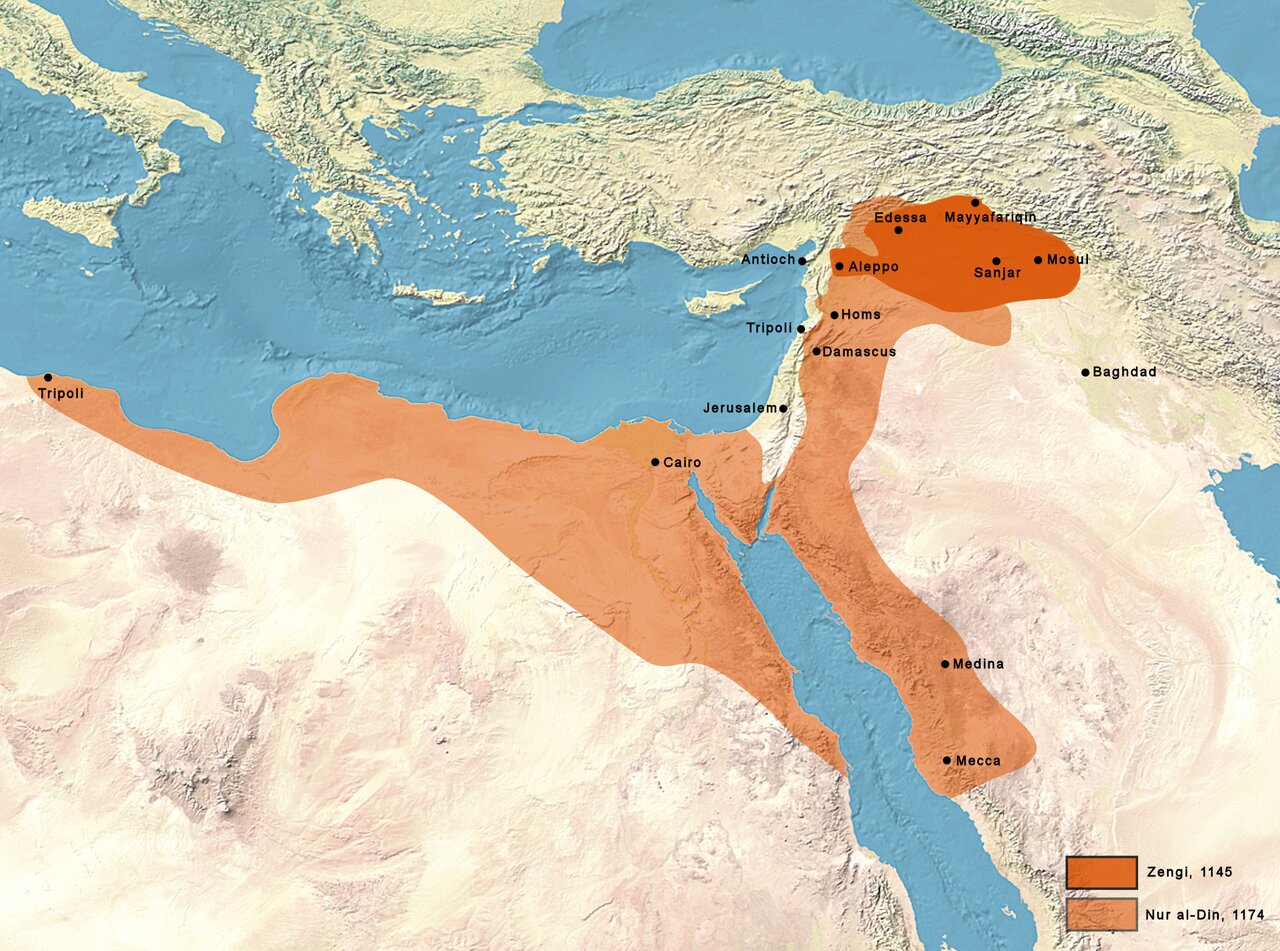
The Zengid Dynasty. The Zengids (1127-1222) were a Turkish dynasty of Syria and the Jazira (Upper Mesopotamia) who led the Muslim counter-offensive against the Crusader states. The founder, Imad al-Din Zengi, a Seljuk officer, took Mosul in 1127 and then Aleppo, uniting northern Syria and the Jazira under one strong ruler for the first time in the Crusading era and using the ideology of jihad to bind his Turkish soldiers and Arab subjects together.
Zengi's masterstroke came in 1144, when he stormed Edessa, the first and most exposed of the Crusader principalities - the shock that provoked the Second Crusade in Europe. Murdered by a servant in 1146, he was succeeded by his son Nur al-Din (r. 1146-1174), who ruled from Aleppo and Damascus, destroyed the Second Crusade's hopes, and completed the encirclement of the Crusader states by taking Egypt: his Kurdish general Shirkuh and Shirkuh's nephew Saladin seized Cairo in 1169, ending Fatimid rule.
Nur al-Din built more than an army: his network of madrasas (Nur al-Din is remembered as the great patron of Sunni madrasas and the first hospital of Damascus), his care for Sunni orthodoxy, and his reputation for justice made him a model Muslim ruler, and his court crafted the public ideology of the Counter-Crusade - uniting the Muslim world for jihad - that Saladin would inherit. On his death his Syrian lands fell to Saladin, who married his widow and took Damascus (1174), while his heirs held Mosul and the Jazira under Saladin's overlordship.
The dynasty's descendants clung to Mosul and the Jazira towns as Ayyubid vassals until the line died out there in 1222. Their historical role was pivotal: Zengi and Nur al-Din broke the Crusaders' security, retook Egypt, and made possible Saladin's victory at Hattin.
 Britannica: Zangid dynasty
 World History Encyclopedia: Zengids & the Crusaders
 Encyclopaedia Iranica: Atabak