 Go Back

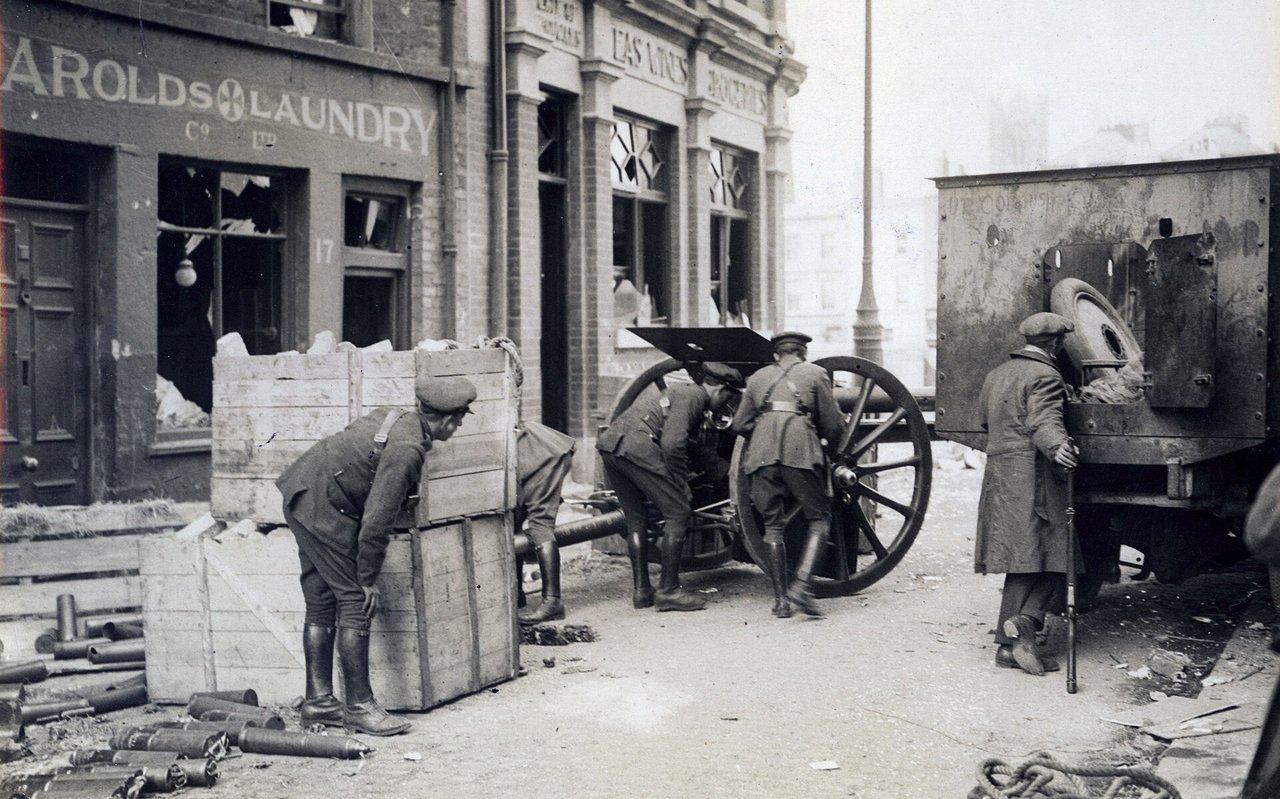
The Anglo-Irish War. In December 1918 Sinn Fein won three-quarters of Ireland's seats, and in January 1919 its elected members refused Westminster and met in Dublin as Dail Eireann, the parliament of the Irish Republic proclaimed in 1916. On the same day, in Tipperary, Volunteers shot dead two policemen escorting gelignite - the opening shots of a war no one had declared. Michael Collins, the Dail's director of intelligence, built the war's machinery: a flying column in every fighting county for ambush and guerrilla war, and in Dublin a squad and a network of spies that struck at the heart of British intelligence.
The war was fought in the dark: the IRA burned barracks and ambushed patrols, the Crown forces - reinforced by the Black and Tans and the Auxiliaries, ex-soldiers turned loose as reprisal squads - answered with sacked towns and murdered suspects, from Croke Park on Bloody Sunday to the burning of Cork. It was ugly, intimate, and unwinnable for both sides: Britain could not reconquer Ireland without a full-scale war it had no stomach for, and the IRA could not fight much longer. In July 1921 both sides took the truce.
The Treaty, signed in London in December 1921 by Collins and Griffith's delegation, gave Ireland dominion status as the Irish Free State - self-government like Canada's, with an oath of allegiance to the Crown, and with Northern Ireland, created by partition in 1921, free to opt out, which it did at once. Collins called it freedom to achieve freedom; de Valera and the republican diehards called it betrayal. The Dail approved it by seven votes, and the movement of Easter Week split in two.
The split became civil war (1922-23), Free State against republican, brother against brother; Collins himself was killed in an ambush in his native Cork. The pro-Treaty side won, at the price of executions harsher than anything the British had done in 1916, and built the state: within the decade the Free State was a functioning democracy, and the Free State was already finding its own course within the Commonwealth. The war of 1919-21 had won for twenty-six counties the independence that six centuries of conquest had refused - at the price of partition and a fratricide whose shadows still lay long.
 Britannica: Irish War of Independence
Britannica: Michael Collins
Britannica: Irish Civil War