 Go Back

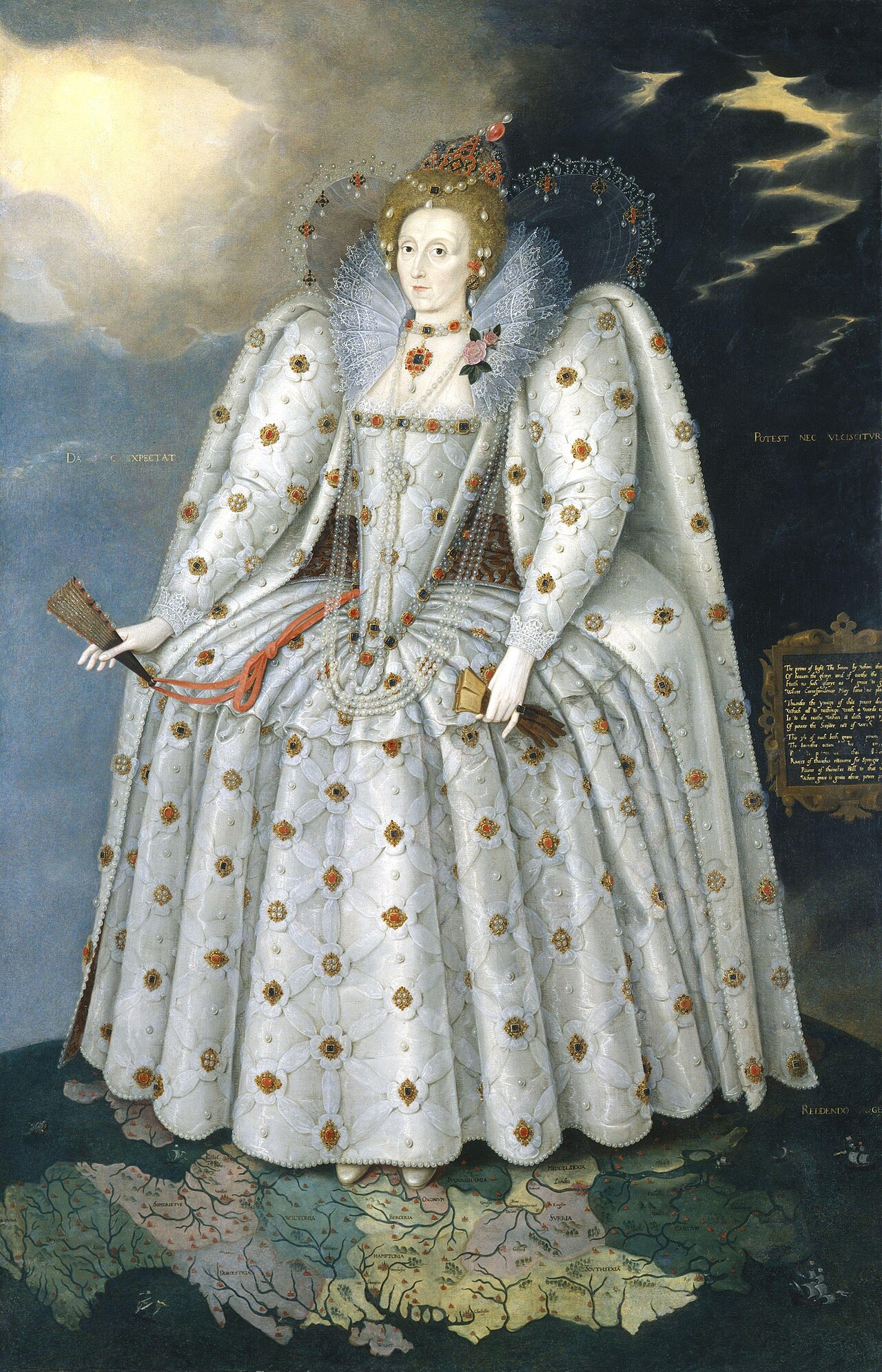
Elizabethan England. Elizabeth I came to the throne in 1558 after the traumas of her siblings' reigns - her brother Edward's radical Protestantism, her sister Mary's Catholic restoration and the burning of heretics - and she ruled for forty-five years, the longest and most storied reign England had known. Her first work was the Elizabethan Settlement: a Church of England Protestant in doctrine but broad enough, she hoped, to hold a divided nation. Her next was survival: excommunicated by the Pope, plotted against by her Catholic subjects in the name of her cousin Mary, Queen of Scots - whom she kept prisoner for nineteen years and at last, in 1587, reluctantly sent to the block.
Elizabeth's England lived by the sea. Merchants and sea-dogs - Drake, Hawkins, Raleigh, Frobisher - pushed English ships into the trades Spain claimed as its own: Drake's circumnavigation (1577-1580) came home laden with Spanish treasure, and his raids on the Caribbean and Cadiz were licensed piracy that filled the queen's coffers. In 1588 Philip II of Spain, exasperated by the raids, the execution of Mary, and English aid to his Dutch rebels, sent the Great Armada: one hundred and thirty ships to escort an invasion army from the Netherlands. In the Channel fights and at Gravelines the faster English gunnery ships harried it, fireships broke its formation, and the weather did the rest; half the Armada was lost on the coasts of Scotland and Ireland.
The defeat of the Armada made Elizabeth a legend - she had ridden to Tilbury to tell her army she had the heart and stomach of a king - and it opened the great age of English confidence. These were the years of Shakespeare's plays, Marlowe, Spenser's Faerie Queene, the madrigal and the miniature; of London doubling in size; of grammar schools, of voyages to Virginia and the East, of a nation intensely aware of itself.
The last decade darkened: the long, ruinous war in Ireland, Essex's rebellion, bad harvests and the queen's own fading. She died in 1603, childless by design - I am married to England - and the crown passed peacefully to her Scottish Stuart cousin. The Elizabethan age fixed England's self-image for four hundred years: Protestant, maritime, and defying the great powers of the continent.
 Britannica: Elizabeth I
Britannica: Spanish Armada
Britannica: Sir Francis Drake