 Go Back

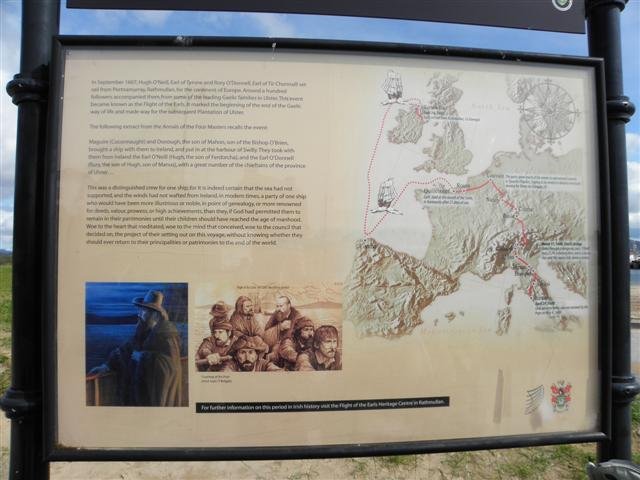
The Flight of the Earls. On 14 September 1607 a French ship slipped out of Rathmullan on Lough Swilly carrying ninety-nine passengers: Hugh O'Neill, Earl of Tyrone, Rory O'Donnell, Earl of Tyrconnell, their families and followers - the last great lords of Gaelic Ulster. Beaten in war, watched by Dublin Castle, and fearing arrest for conspiracies real or invented, they sailed for Spain and ended in Rome, where Tyrone died in 1616. They meant, most believed, to return with foreign help. They never came back, and Gaelic Ireland's old leadership went with them.
Into the vacuum came the Plantation of Ulster. The flight was judged treason, and six counties - Armagh, Cavan, Donegal, Fermanagh, Tyrone and Coleraine, some half a million acres - were declared forfeit to the crown. The lands were measured out to undertakers, English and Scottish landlords bound to settle British tenants, build bawns and castles, and keep no Irish on the best land. The City of London's guilds took Coleraine, rebuilt Derry within walls that still stand, and gave it their name: Londonderry.
The plan drew a new map of peoples. Tens of thousands of lowland Scots and northern English crossed to Ulster in the following decades - farmers, weavers, smiths - settling beside a dispossessed Irish population that remained on the poorer lands as laborers and tenants. English, Scots and Irish, Protestant and Catholic, were planted cheek by jowl in the most deliberately engineered colonization of the British Isles, and the province's divided character ever since was laid down in those decades.
The dispossessed did not forget. In October 1641 the Irish of Ulster rose under Sir Phelim O'Neill to seize back what had been taken, and the rising - with its massacres of settlers, grotesquely magnified in the telling - ignited a decade of war and a new cycle of confiscation under Cromwell and the Restoration. The Flight of the Earls had been meant to end the Irish question in the north; it made Ulster instead the hardest knot in the islands' history, still being untied four centuries later.
 Britannica: Flight of the Earls
Britannica: Ulster
Britannica: Ireland - The Tudor Conquest