 Go Back

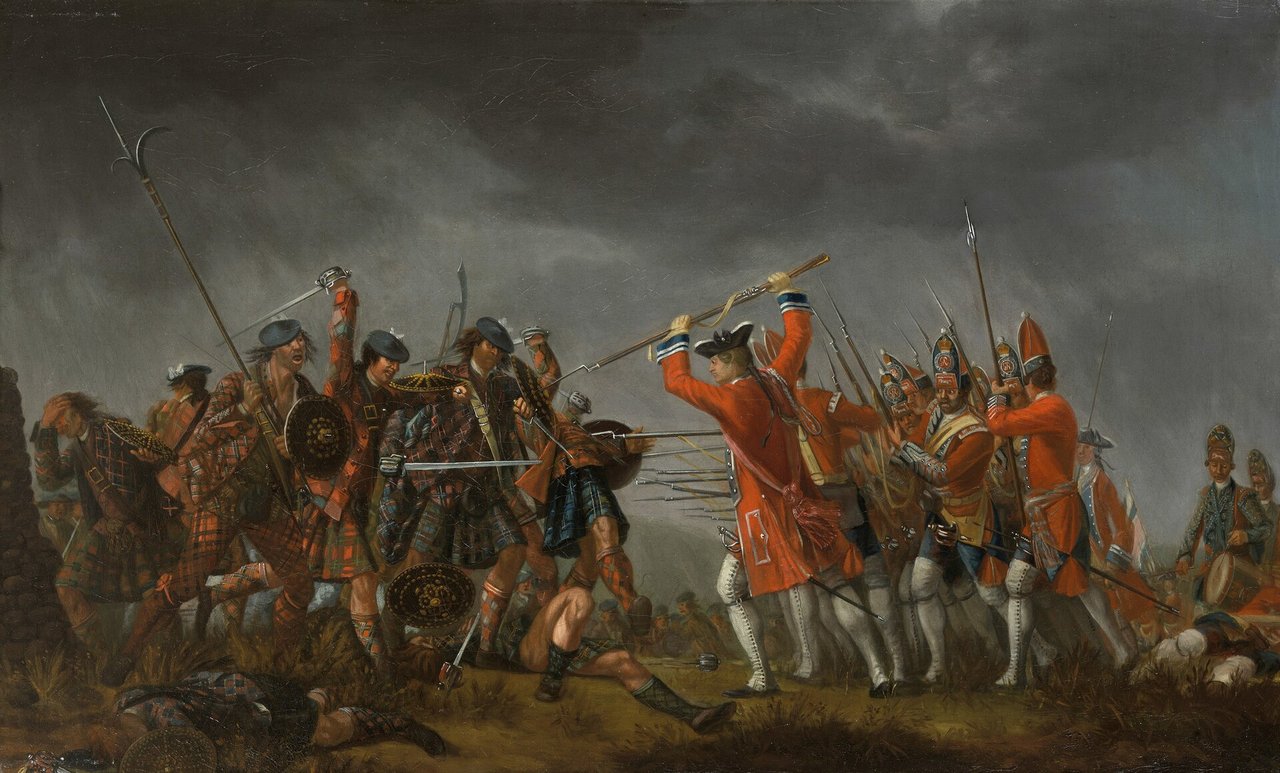
The Jacobite Risings. When the Catholic James VII and II was driven from his thrones in 1688, his cause - Jacobitism, from Jacobus, Latin for James - refused to die. For sixty years the exiled Stuarts plotted their return from France and Rome, and their most loyal army was the Highlands of Scotland, where the clan chiefs kept the old faith, the old feuds, and a feudal levy of broadsword and targe. The risings came in waves: Killiecrankie in 1689, where Dundee's clans won and died; then, after the Union of 1707 doubled Scotland's discontents, the great attempts.
The Fifteen (1715) rose for James VIII, the Old Pretender: the Earl of Mar raised the clans, fought a draw at Sheriffmuir, and let the moment die before James even landed. The Forty-Five was the romantic last throw: in July 1745 Charles Edward Stuart - Bonnie Prince Charlie - landed in the Hebrides with seven companions, raised his father's standard at Glenfinnan, and led a Highland army to a stunning victory at Prestonpans, took Edinburgh, and in December marched into England as far as Derby, one hundred and twenty miles from London, with the capital in panic.
At Derby the chiefs forced the retreat - no English Jacobites had risen, and two armies lay between them and London. The clans fell back north through the winter, and on 16 April 1746, on the flat moor of Culloden near Inverness, five thousand hungry Highlanders charged into the muskets and cannon of the Duke of Cumberland's army. It was over in an hour; the wounded were finished where they lay. Charles wandered five months in the heather, sheltered by Flora MacDonald and the poorest of the poor, and escaped to France and a long, sodden exile.
The state answered Culloden with the destruction of the world that had made it: the Disarming Act, the banning of tartan and bagpipes, the abolition of heritable jurisdictions - the chief's power of life and death - and garrisons and roads driven into the glens. Jacobitism died, and within a generation the same Highlands supplied the British army its most famous regiments; the tartan came back as pageantry for George IV's Edinburgh visit in 1822, staged by Walter Scott. The rising of the clans had failed - and conquered the world's imagination.
 Britannica: Battle of Culloden
Britannica: Charles Edward, the Young Pretender
Britannica: Jacobite