 Go Back

The Penal Laws. After the Williamite victory, the Protestant minority that owned Ireland legislated to make sure it could never be challenged. Between 1695 and 1728 the Irish parliament - from which Catholics were excluded - passed the body of statutes remembered as the penal laws. Catholics were barred from Parliament, the law, the army, the universities and public office; forbidden to buy land from Protestants, to inherit it whole, to carry arms, to own a horse worth more than five pounds, to teach school or to go abroad for education. Catholic worship itself was regulated and its bishops banished.
The deepest cuts were economic. The law of gavelkind forced a Catholic's land to be divided among all his sons, splintering estates with every generation - unless one son conformed to the established church, in which case he took it all. The aim was not to convert the Irish, as even the Ascendancy admitted, but to impoverish and disarm them. In practice the laws were enforced unevenly: great Catholic merchants quietly grew rich in the ports, and the countryside kept its priests and its hedge schools, where a barefoot schoolmaster taught Latin and Greek behind a hedge.
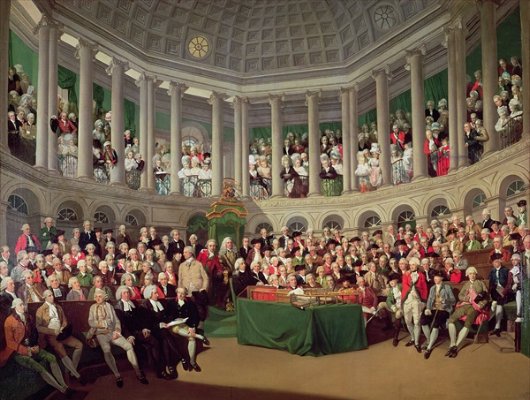
The eighteenth century in Protestant Ireland was the age of the Ascendancy at its ease: Dublin grew into the second city of the British Isles, graced with the Custom House, the Four Courts and the wide Georgian squares that still define it, while its parliament - Grattan's Parliament after 1782 - won a measure of legislative independence. It was an elegant prosperity resting on exclusion: the great majority of the nation were tenants without rights, and tithes for a church they did not attend were collected from Catholic cottiers at the point of distress.
The system rotted from within and without. The French Revolution and the rising of 1798 terrified London into union, and the penal laws themselves were progressively repealed: the franchise in 1793, most offices over following decades, and in 1829 Daniel O'Connell's mass movement forced Catholic Emancipation through a frightened Parliament. But the memory of the penal era - the five-pound horse, the hedge school, the priest-hunter - entered the Irish national story as its century of humiliation, and powered the politics that followed.
 Britannica: Penal Laws
Britannica: Ireland - The 18th Century
Britannica: Henry Grattan