 Go Back

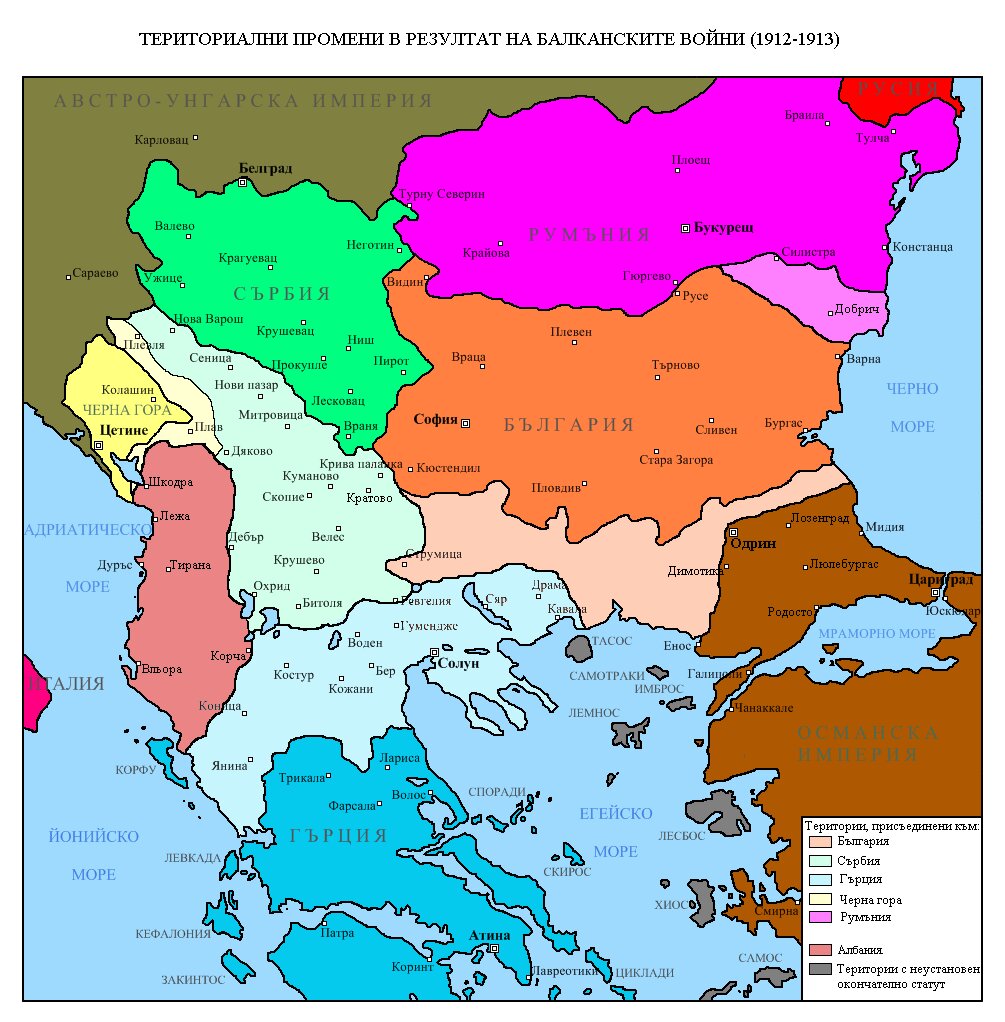
The Balkan Wars of 1912-1913 destroyed Ottoman power in Europe and set the stage for the First World War. Behind them lay the slow Ottoman retreat from the Balkans and the ambitions of the new Christian states, Serbia, Bulgaria, Greece and Montenegro, whose peoples still lived under Ottoman rule in Macedonia, Albania and Thrace. In 1912, encouraged by Russian diplomacy and by Italy's war with the Ottomans in Libya, the four states formed the Balkan League, and in October 1912 they attacked together. The First Balkan War was a rout: the Serbs took Kosovo and Macedonia, the Greeks took Thessaloniki, just ahead of the Bulgarians, and the Bulgarians drove to within miles of Constantinople, while the great powers recognized an independent Albania to keep Serbia off the Adriatic.
The victors immediately fell out over the spoils. Bulgaria, which had done the heaviest fighting, claimed most of Macedonia; Serbia, shut out of Albania, demanded compensation there; Greece and Romania also held claims against Sofia. When negotiations failed, Bulgaria attacked its former allies on 29 June 1913, opening the Second Balkan War. Serbia, Greece, Montenegro and Romania, which seized southern Dobruja, all counterattacked, and the Ottoman Empire returned to recover Adrianople (Edirne). Within a month Bulgaria was crushed and forced to sign the Treaty of Bucharest (August 1913), losing territory on every side.
The wars doubled the size of Serbia, Greece, Montenegro and Romania, cut the Ottoman Empire back to a corner of Thrace, and confirmed Albanian independence. But they left three poisonous legacies. First, a humiliated Bulgaria nursed revenge, joining the Central Powers in 1915 to recover what it had lost. Second, a triumphant Serbia, now twice its size, terrified Austria-Hungary, which saw South Slav nationalism, armed by Belgrade, reaching into its own provinces; the Sarajevo assassination of June 1914 grew directly from the wars' settlement. Third, the wars introduced mass ethnic violence into southeastern Europe: villages burned, populations expelled, atrocities documented by an international commission of 1914 that read like a preview of the century to come.
The Balkan Wars also revealed the great powers' near-paralysis: Austria-Hungary mobilized, Russia backed Serbia, and the Concert of Europe, through the London Conference of ambassadors, managed only to draw Albania's borders while the fighting decided everything else. When the next Balkan crisis came in July 1914, no one believed diplomacy would contain it, and the alliance system that had kept the peace for forty years pulled Europe into a general war in a matter of weeks.
 Britannica: Balkan Wars
New World Encyclopedia: Balkan Wars