 Go Back

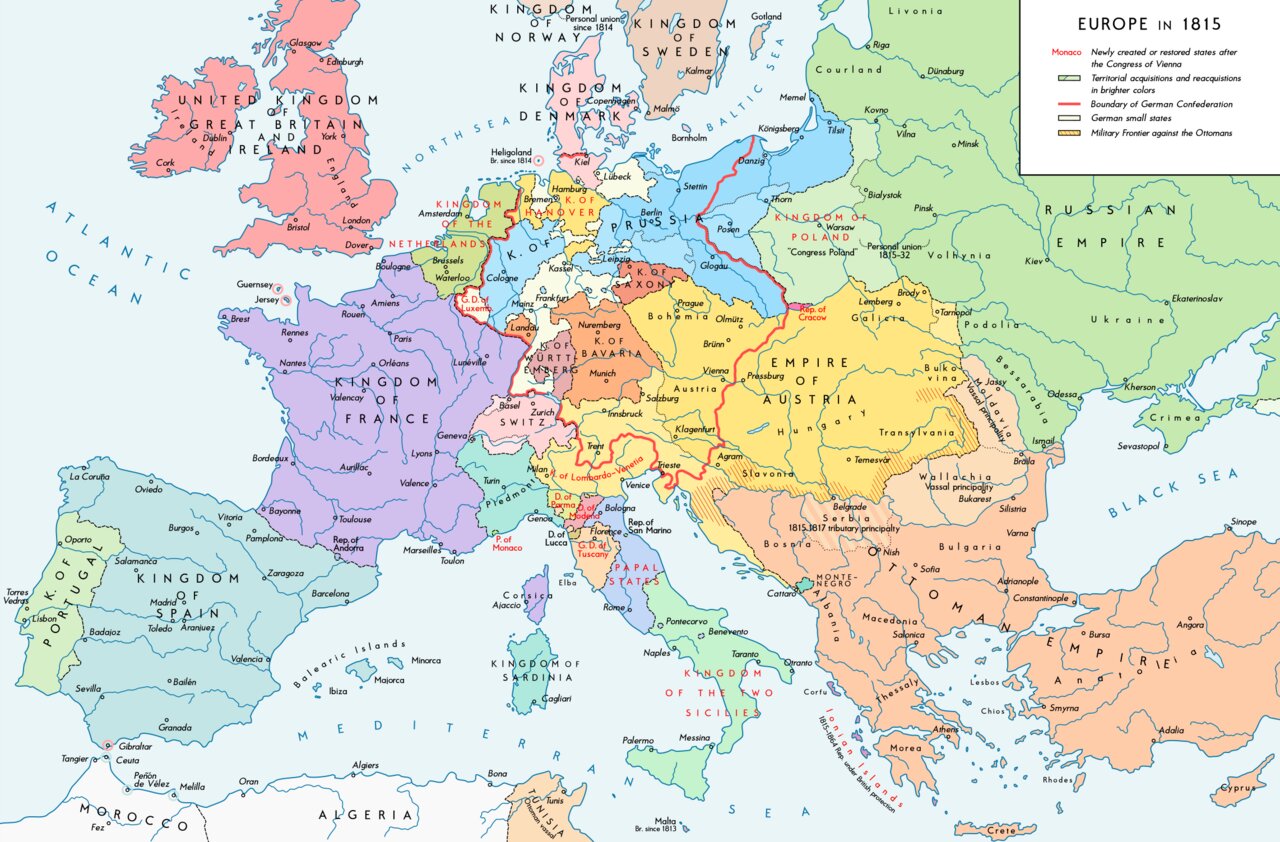
The Concert of Europe was the informal system of great-power consultation that managed European affairs for a century, from the Congress of Vienna in 1815 to the First World War. It had no charter, no headquarters and no rules; it rested on two ideas: that the five great powers, Britain, Austria, Russia, Prussia and, from 1818, France, shared a common interest in preventing any one of them from dominating the continent, and that general war could be avoided if the powers met to settle dangerous questions together before fighting over them. The Vienna settlement itself, partitioning Europe by dynastic legitimacy and balance of power, was its founding act, and the Quadruple Alliance's congresses were meant to be its instrument.
The early Concert worked through congress diplomacy: Aix-la-Chapelle (1818) admitted France to the club; Troppau, Laibach and Verona (1820-1822) quarreled over Austria's suppression of the Italian revolutions, driving Britain toward separation. The system bent but held through its first crises: Greek independence was managed jointly in 1827-1832 against the principle of legitimacy; Belgium's secession from the Netherlands (1830-1839) was negotiated into guaranteed neutrality; the Eastern crises of 1840 and 1878 were settled at London and Berlin without general war. Even the Crimean War (1853-1856), the Concert's worst failure, ended in a congress at Paris that readmitted the Ottoman Empire to the system.
The mid-century wars of unification tested the Concert and, surprisingly, left its habit intact: Prussia's wars of 1864-1871 redrew the map without a general coalition forming against it, and Bismarck, having unified Germany, became the Concert's chief manager, his alliance system, the Congress of Berlin (1878), and the Mediterranean agreements all designed to localize conflicts and keep France isolated. After Bismarck's fall in 1890 the system's threads loosened: alliances hardened into the Triple Alliance and the Franco-Russian, then Anglo-French, blocs, imperial rivalries moved competition to Africa and Asia, and the arms race and war plans made mobilization schedules stronger than diplomacy.
The Concert still scored late successes, the Algeciras Conference (1906) on Morocco, the London Conference (1912-1913) that drew Albania's borders after the Balkan Wars, but each success came at the price of entrenching the two armed camps. When the July Crisis of 1914 began, Austria-Hungary deliberately avoided the conference method that had defused earlier crises, Germany backed its ultimatums, Russia mobilized, and the alliance machinery the Concert had failed to replace pulled Europe into general war. The League of Nations and, later, the United Nations and the European Union were all, in different ways, attempts to give the Concert's idea, peace through consultation among powers, the permanent institutions it had always lacked.
 Britannica: Concert of Europe
New World Encyclopedia: Concert of Europe