 Go Back

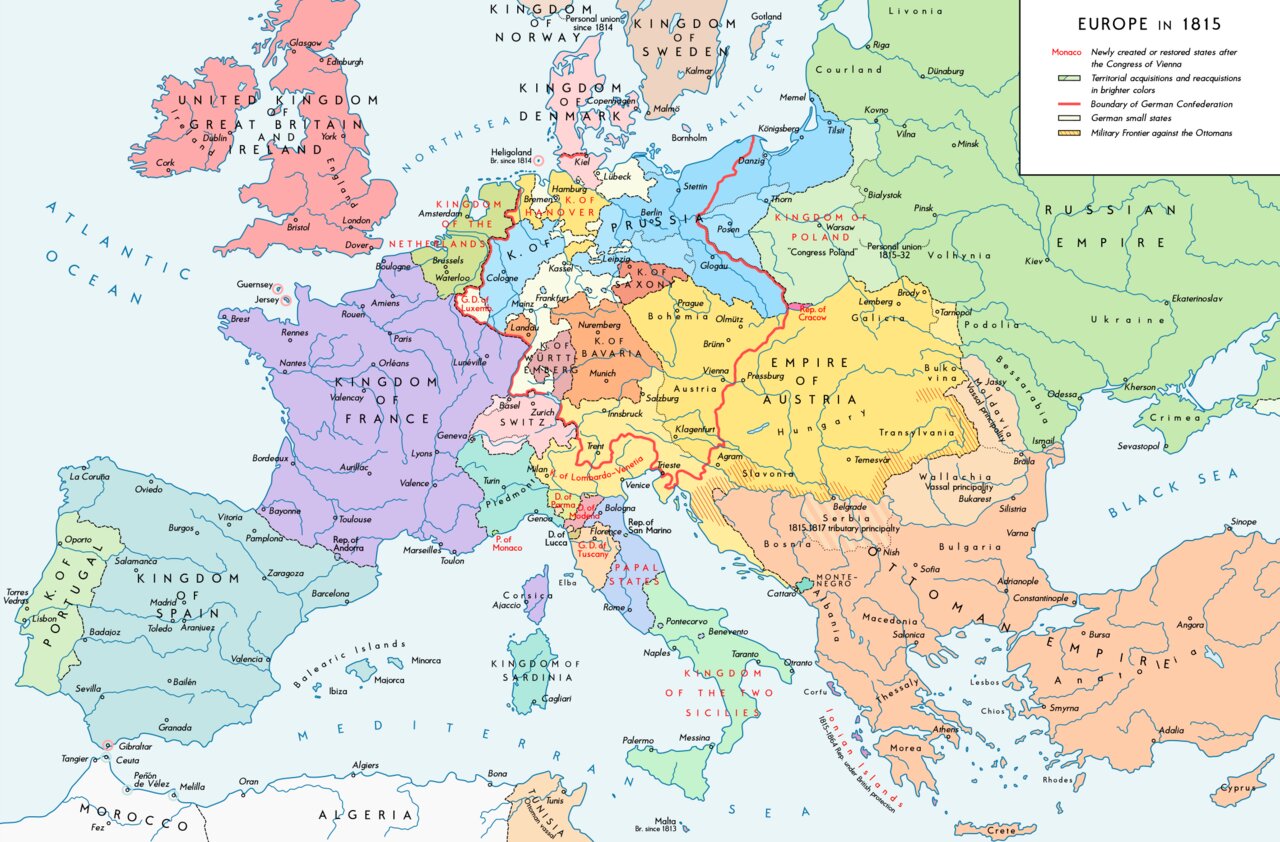
The Congress of Vienna (September 1814 - June 1815) was the great peace conference that rebuilt Europe after more than twenty years of Revolutionary and Napoleonic war. Nearly every state and court of Europe sent representatives to the Austrian capital, where the Austrian foreign minister Metternich, Britain's Castlereagh, Prussia's Hardenberg, Russia's Tsar Alexander I, and, most skillfully, France's Talleyrand, representing the defeated power, bargained over the map while the city danced. The guiding principles were legitimacy, restoring the old dynasties Napoleon had displaced, the balance of power, so no state could again dominate Europe, and compensation for the victors' losses and efforts.
The territorial settlement redrew the continent. France returned roughly to its 1792 borders. To contain it, the Dutch Republic and the Austrian Netherlands were merged into a Kingdom of the Netherlands, Prussia received the Rhineland, and Austria kept Lombardy and Venetia. Austria and Prussia were compensated in Italy and Germany for the Polish lands lost to Russia, which kept most of Napoleon's Grand Duchy of Warsaw as 'Congress Poland'. The Holy Roman Empire, dissolved in 1806, was not restored; instead thirty-nine German states formed a loose German Confederation under Austrian presidency. Sweden kept Norway, taken from Denmark, and Britain kept Malta, the Cape of Good Hope and Ceylon.
The negotiations were interrupted in March 1815 by Napoleon's escape from Elba and his Hundred Days, which ended at Waterloo in June; the second Treaty of Paris (1815) then imposed harsher terms on France, an indemnity and an army of occupation. To preserve the settlement, Alexander I promoted the Holy Alliance of Christian monarchs, while Austria, Prussia, Russia and Britain formed the Quadruple Alliance, pledging to meet in congresses to maintain the peace, the beginning of the 'Congress System' at Aix-la-Chapelle, Troppau and Laibach.
The Vienna settlement gave Europe nearly forty years without a general war, an achievement no previous peace had matched. Its conservative order, defended by Metternich's Carlsbad Decrees and occasional interventions, suppressed the liberal and national movements the revolutionary era had unleashed, but only until they burst out in 1830 and 1848. Belgium seceded from the Netherlands in 1830, and German and Italian unification later demolished the map, yet the balance-of-power system Vienna created, and the idea of settling affairs by congress diplomacy, shaped European statecraft to 1914 and beyond.
 Britannica: Congress of Vienna
 Encyclopedia.com: Congress of Vienna