 Go Back

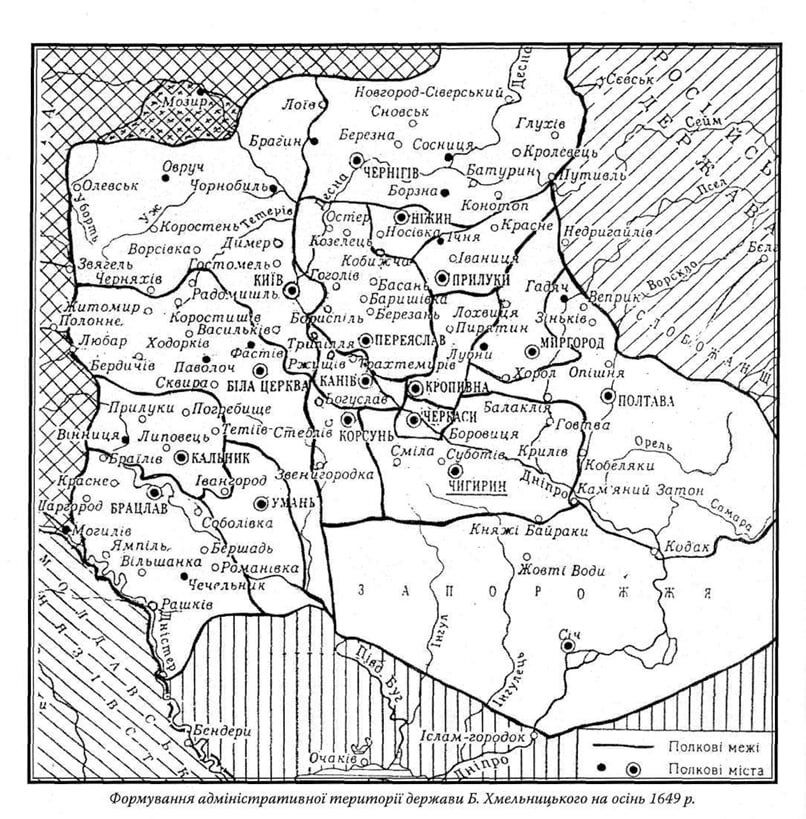
The Cossack Hetmanate was the semi-autonomous Cossack state that ruled central Ukraine for over a century after the uprising of Bohdan Khmelnytsky in 1648. Its roots lay in the Zaporozhian Cossacks, the self-governing warrior host 'beyond the rapids' of the Dnieper, runaway serfs, frontiersmen and freebooters who raided the Crimean Khanate and the Ottoman Black Sea, and who chafed under Polish-Lithuanian rule that treated them as a resource to be registered and limited. Tensions over noble encroachment, the curbing of the Cossack register, and the persecution of the Orthodox faith in the Commonwealth's borderlands exploded in 1648, when Khmelnytsky, wronged by a Polish official, allied with the Crimean Tatars and destroyed two Polish armies at Zhovti Vody and Korsun.
The revolt became a war of liberation that redrew eastern Europe. Khmelnytsky's armies, swollen by peasants, swept the Commonwealth's eastern lands in upheavals that included massacres of Polish nobles and of Jews, tens of thousands of whom died as agents of the hated regime. Unable to win the war outright against a resurgent Poland, Khmelnytsky sought a protector, and by the Treaty of Pereyaslav (1654) he placed the Cossack Host under the tsar of Muscovy, an act whose meaning, alliance or submission, Russia and Ukraine have argued ever since. The Russo-Polish War that followed (1654-1667) devastated Ukraine, and the Truce of Andrusovo divided it: the left bank of the Dnieper and Kiev to Russia, the right bank to Poland.
In the left-bank territories the Hetmanate survived as an autonomous state under its elected hetmans, with its own regiments, chancellery, courts and foreign relations, within the tsar's growing empire. Its golden age came under Ivan Mazepa (1687-1709): Cossack baroque churches and schools flourished, the Kyiv-Mohyla Academy made Kiev an intellectual center, and the hetman governed as a prince. But Peter the Great's demands in the Great Northern War, Cossack lives spent in northern campaigns, tsarist interference in elections, pushed Mazepa to defect to Charles XII of Sweden in 1708. Poltava destroyed them both: Mazepa died in exile, and Peter's reprisals razed the Zaporozhian Sich and tightened the screws.
After Mazepa, autonomy was dismantled in stages: Peter imposed a Russian 'Little Russian Collegium', Catherine II abolished the hetmanate entirely in 1764 and the Sich itself in 1775, and serfdom was extended over the formerly free Cossack lands. The Hetmanate's regimental territories became the guberniyas of the Russian Empire. Yet the Hetmanate left a durable legacy: the office, the regiments and the Cossack myth became central to Ukrainian national identity, and the memory of Pereyaslav and Mazepa, partnership or treachery, submission or sovereignty, still frames the way Ukraine and Russia tell their shared history.
 Britannica: Cossack
Britannica: Hetman