 Go Back

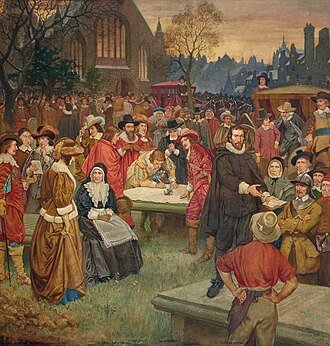
The Covenanters. In 1637 Charles I and his archbishop, William Laud, imposed a new English-style prayer book on Presbyterian Scotland. When it was first read in St Giles' Cathedral in Edinburgh, tradition says a market-woman named Jenny Geddes threw her stool at the minister's head - and Scotland rose. In February 1638 the nation signed the National Covenant: a bond, sworn by nobles, ministers, merchants and ploughmen on their knees in Greyfriars Kirkyard and in every parish, to defend the Presbyterian Kirk against royal interference. The Covenanters would tolerate no king between a Scot and his God.
Covenanting Scotland beat its king. In the Bishops' Wars of 1639-40 the Army of the Covenant out-marched and out-organized Charles's levies, and in 1640 a Scottish army occupied Newcastle and dictated terms. The king's weakness summoned the English Parliament that would fight the Civil War - and in 1643 the Covenanters joined it, sending an army south under the Solemn League and Covenant, which helped win Marston Moor. But when the English revolution devoured itself and executed Charles in 1649, the horrified Covenanters crowned his son - and Cromwell came north to destroy their armies at Dunbar and Worcester's forerunner at Inverkeithing.
At the Restoration, Charles II had his revenge: episcopacy was reimposed, and the ministers who refused it were driven from their parishes to preach at open-air conventicles in the hills. The later Stuart persecution - the Killing Time of the 1680s - hunted the field-preachers with dragoons; the Cameronians of the southwest answered with arms and martyrdom. The names of the martyrs, and the graves in the kirkyards of Galloway, entered the memory of Presbyterian Scotland and Presbyterian Ulster, where thousands of Scots carried the Covenant across the water.
The Glorious Revolution of 1688 ended the struggle: in 1690 the Scottish Parliament abolished bishops forever and established the Presbyterian Church of Scotland, which endures as the national church. The Covenanters' stubborn theology left a double legacy - a democratic kirk governed from below, and a tradition of conscience against power that echoed far beyond Scotland, in Ulster and in America.
 Britannica: Scotland - The Covenanters
Britannica: Bishops' Wars
Britannica: William Laud