 Go Back

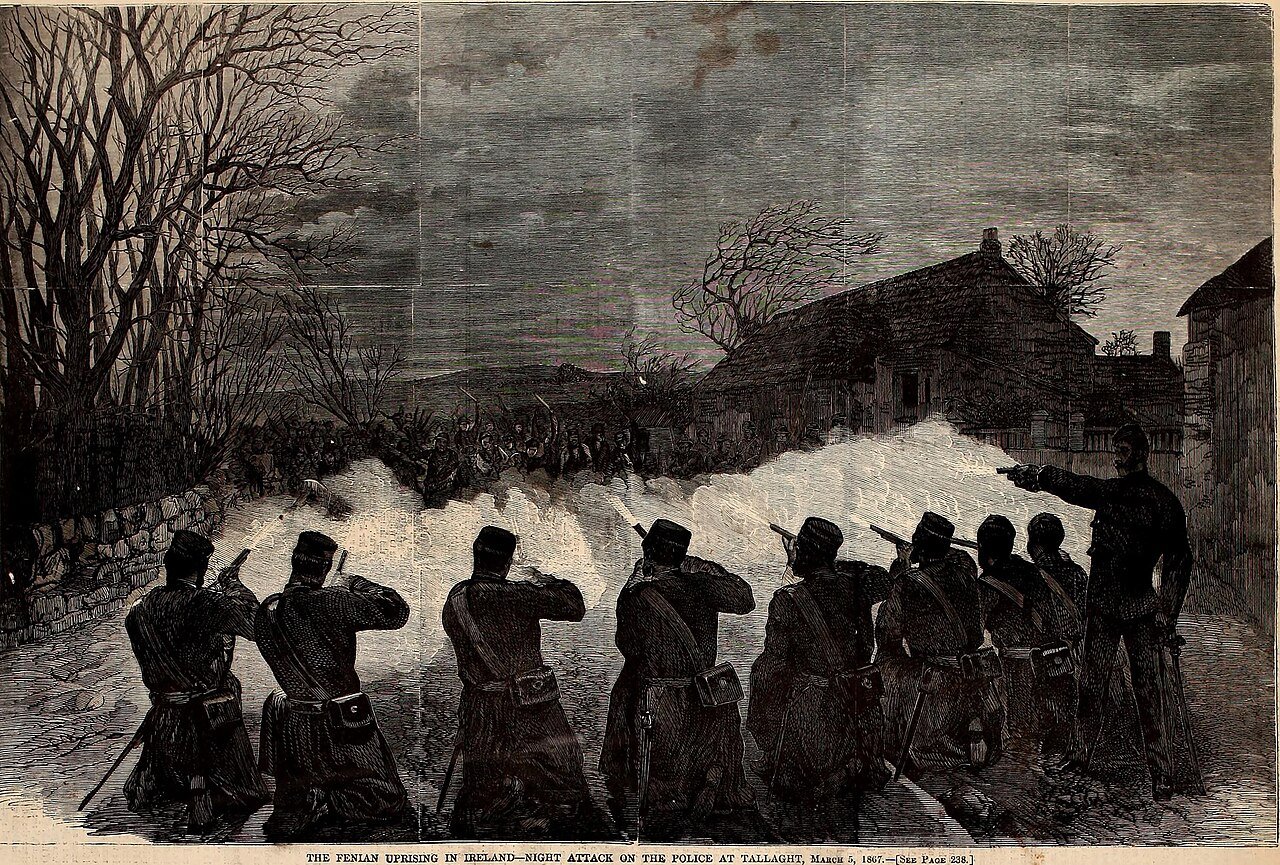
The Fenians. Out of the Famine generation came men who concluded that Ireland would never be freed by meetings and petitions. In 1858 James Stephens in Dublin and John O'Mahony in New York founded a secret, oath-bound revolutionary brotherhood - the Irish Republican Brotherhood at home, the Fenian Brotherhood among the emigrants in America - dedicated to one end: an Irish republic, won by force of arms. They took their name from the Fianna, the warrior band of Irish legend, and they invented the model of the modern revolutionary underground: cell structure, secret oath, a newspaper, and money from the diaspora.
Fenianism's strength was the Famine's legacy: hundreds of thousands of Irish in America, many of them fresh from the Union and Confederate armies, trained, armed and bitter. The movement dreamed of a war on two fronts - insurrection in Ireland, invasion of Canada from the United States. Fenian raiders actually crossed the Canadian border in 1866 and won a skirmish at Ridgeway before dispersing; in Ireland the brotherhood recruited deep into the British army itself, among the Irish soldiers of the garrison.
The government struck first, sweeping up the leadership in 1865. The rising, when it finally came in March 1867, was a forlorn hope: scattered bands in Kerry, Limerick, Tipperary and Cork attacked police barracks in a late-winter blizzard and were scattered in days. What made the Fenians immortal was not the fighting but the aftermath - the Manchester Martyrs, three Fenians hanged in 1867 for a rescue in which a policeman was shot, and the Clerkenwell prison explosion that killed Londoners in the cause. God save Ireland, sung by the Manchester three at their trial, became the anthem of a movement.
The rising failed, and Fenianism's violence split Irish opinion, but the tradition did not die: it became the backbone of physical-force republicanism, the ideology of 1916. And the Fenian scare had one great constitutional consequence - it convinced William Gladstone that Ireland's grievances were real, setting in train fifty years of reform: the disestablishment of the Irish church, the land acts, and at last Home Rule itself.
 Britannica: Fenian
 Raids
Britannica: Manchester Martyrs