 Go Back


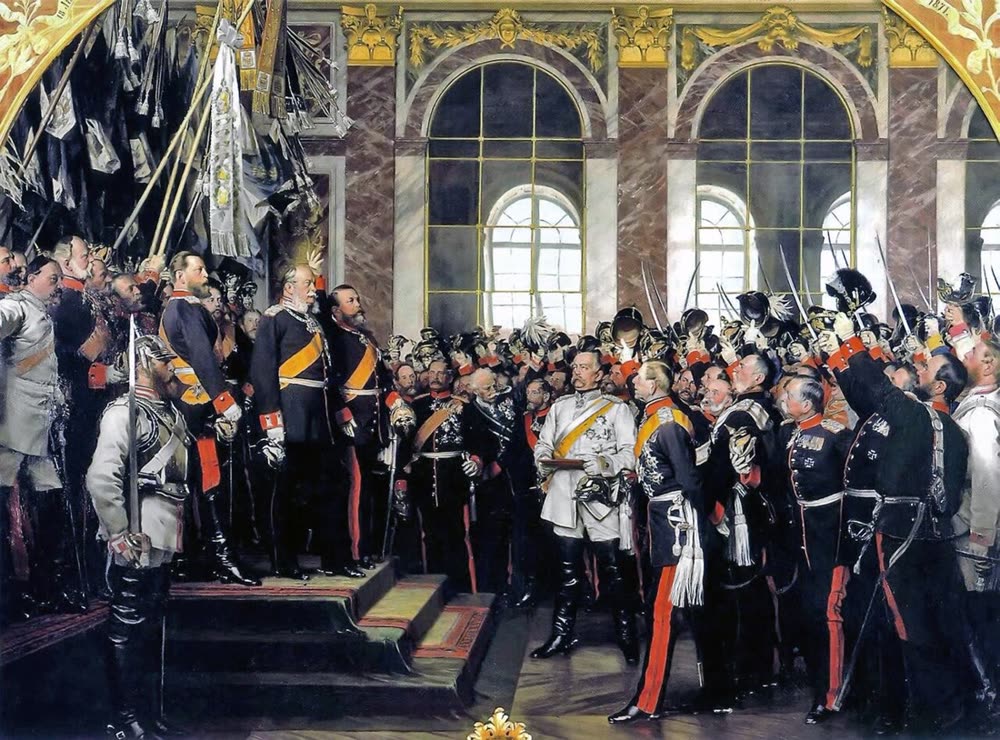
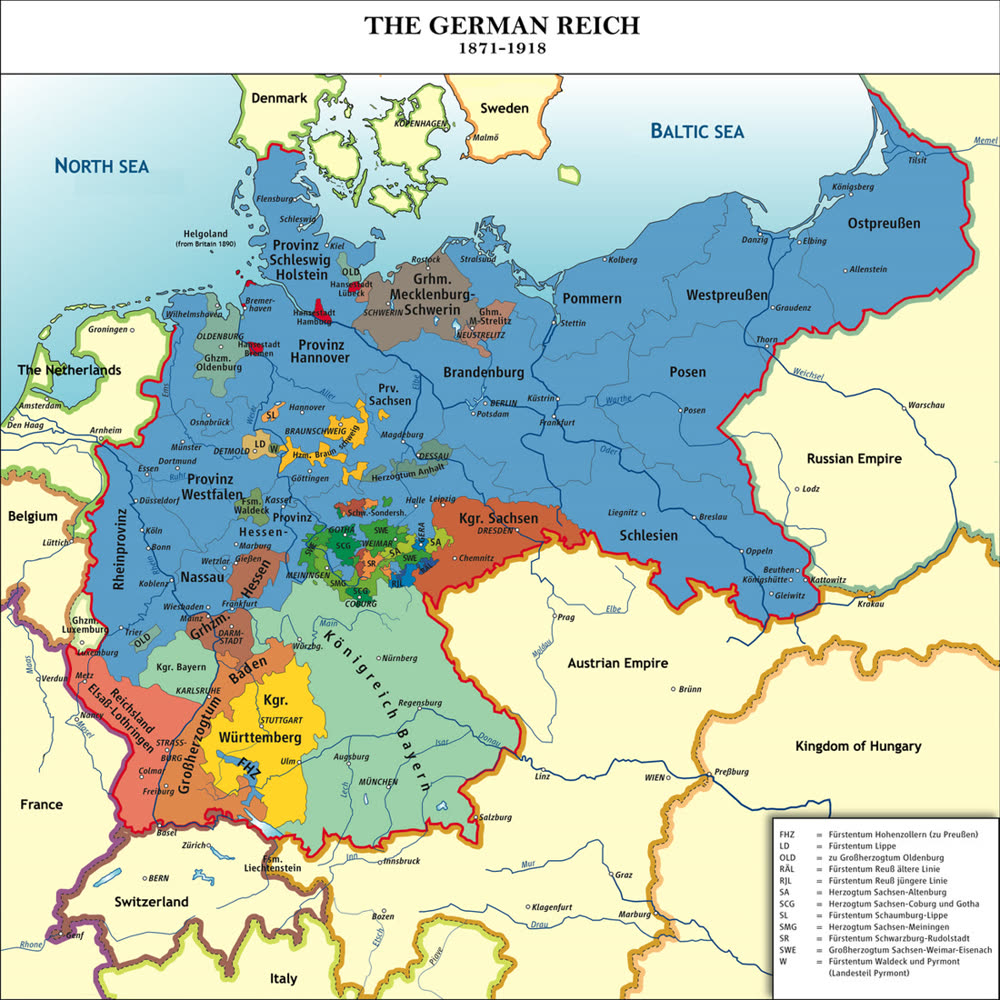
The German Empire - the Second Reich - was proclaimed on 18 January 1871 in the Hall of Mirrors at Versailles, while German armies still besieged Paris, and it lasted until the revolution of November 1918. It was a federation of 25 states: four kingdoms led by Prussia, plus grand duchies, duchies, principalities, and three free cities, each keeping its own ruler and government for internal affairs. Its birth marked the end of centuries of German division and the arrival of a new Great Power in the center of Europe.
Unification was the work of Prussia and its minister-president Otto von Bismarck, who had declared in 1862 that the great questions of the day would be decided not by speeches and majority votes 'but by iron and blood.' In three short wars he made it so: Denmark was defeated in 1864 over Schleswig-Holstein, Austria was knocked out of German affairs in a few weeks in 1866 - Bismarck deliberately sparing it humiliation so it could be a future ally - and France was provoked into declaring war in 1870. The Franco-Prussian War was over by early 1871; Napoleon III himself was captured in the field. The victory swept the southern German states into union with Bismarck's North German Confederation, and King Wilhelm I of Prussia became German emperor.
As the empire's first chancellor from 1871 to 1890, Bismarck dominated its first two decades. At home he built a unified national state: a common currency, law codes, and the world's first modern welfare system - health insurance, accident insurance, and old-age pensions - introduced partly to undercut the fast-growing socialist movement he simultaneously tried to suppress. His Kulturkampf, the campaign to break the Catholic Church's influence over schools and public life, failed and was abandoned. Abroad he built a web of alliances meant to keep the peace and isolate France: the Dual Alliance with Austria-Hungary in 1879, joined by Italy in 1882, and a series of agreements with Russia and Britain. Under him Germany became the leading industrial and military power of continental Europe.
The accession of Wilhelm II in 1888 changed the tone. The young kaiser dismissed Bismarck in 1890 and let the Russian treaty lapse, and his assertive personal diplomacy, his pursuit of overseas colonies, and above all his program of building a battle fleet to rival Britain's alarmed Germany's neighbors. Step by step the encirclement Bismarck had feared took shape: France and Russia allied in the 1890s, and Britain settled its old quarrels with France and drew close to both.
When the European crisis of 1914 came, Germany went to war beside Austria-Hungary. Four years of total war, blockade, and attrition destroyed the empire: the home front starved under the British blockade while the army consumed the state's authority. Defeat in the west in autumn 1918 brought collapse with startling speed - sailors mutinied at Kiel in late October, revolution spread through the cities in the first days of November, and on 9 November 1918 Wilhelm II abdicated and a republic was proclaimed. The Second Reich was dead at forty-seven.
 Britannica: German Empire
 Khan Academy: Client Challenge
 BBC: History - Otto von Bismarck
 Humanities LibreTexts: 4.5: Germany