 Go Back

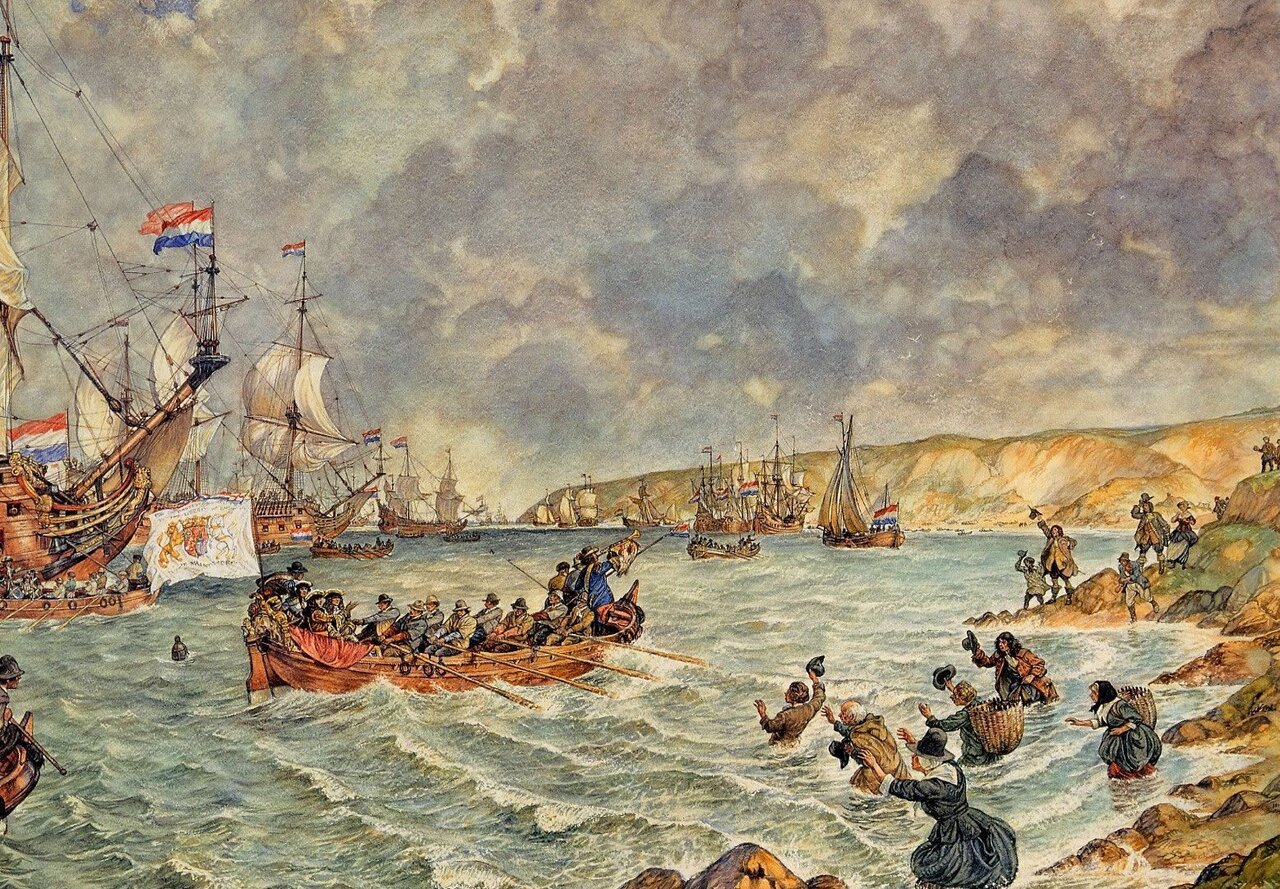
The Glorious Revolution (1688-1689) replaced the Catholic James II of England with his Protestant daughter Mary and her husband William III of Orange, and settled the English constitution on parliamentary terms. James, succeeding his brother Charles II in 1685, alienated the political nation within three years: he suspended the Test Acts by royal prerogative, kept a standing army near London, promoted Catholics to office, and prosecuted seven bishops who petitioned against his religious policy. The birth of a son, and Catholic heir, in June 1688 ended hopes that his rule was a temporary Catholic interlude, and seven leading Englishmen invited William, stadtholder of the Dutch Republic, to intervene.
William landed at Torbay on 5 November 1688 with a Dutch army of some 15,000, claiming to defend England's religion and liberties and to call a free Parliament. James's army, larger but unreliable, melted as officers and even his daughter Anne deserted; James attempted flight, was allowed to escape to France, and the revolution was effected with almost no fighting in England, though it took real wars to impose in Scotland and Ireland, where the Jacobites were defeated at the Boyne (1690) and Aughrim (1691).
In January 1689 the Convention Parliament declared that James, by fleeing, had abdicated, and offered the crown jointly to William and Mary. The offer came with conditions: the Declaration of Right, enacted as the Bill of Rights (1689), condemned James's abuses and laid down that no monarch could suspend laws, tax without Parliament, maintain a standing army in peacetime without consent, or interfere with elections and parliamentary speech; and it barred Catholics, or anyone married to a Catholic, from the throne. The Toleration Act (1689) gave limited freedom to Protestant dissenters, and the Mutiny Act and annual supply made Parliament a permanent part of government.
The revolution's consequences reached far. In Britain it established parliamentary monarchy, party politics, and the financial revolution, the Bank of England (1694) and a funded national debt, that underwrote Britain's wars and empire. Internationally it brought England into William's Grand Alliance against Louis XIV, beginning the 'Second Hundred Years' War' between Britain and France. In political thought, John Locke's Two Treatises justified government by consent and resistance to tyranny, feeding later liberalism, while Jacobitism, the claim of James's line, kept rebellion alive in Scotland until Culloden (1746). 'Glorious' meant, above all, bloodless and lawful: a revolution made to look like no revolution at all.
 Britannica: Glorious Revolution
 World History Encyclopedia: Glorious Revolution