 Go Back

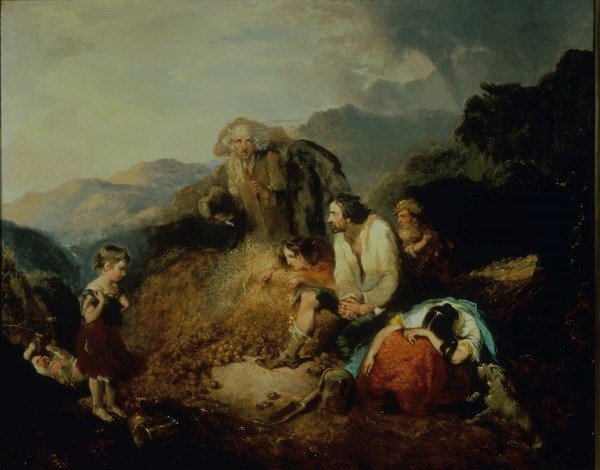
The Great Famine. In September 1845 a strange blight appeared on the potato fields of Ireland - leaves blackened overnight, and the tubers in the ground turned to stinking pulp. Phytophthora infestans had come from America to Europe, and in Ireland it struck the one country where a third of the people ate almost nothing but potatoes: fourteen pounds a day for an adult laborer, with buttermilk, on plots too small for any other crop to sustain. The blight returned in 1846, worse, and again in 1848. The food of four million people simply ceased to exist.
Hunger became starvation, and starvation brought the fevers - typhus and relapsing fever - that killed more than hunger did. The roads filled with walking skeletons; families were found dead in their cabins with grass in their mouths; workhouses overflowed and closed their gates. And all through it, Ireland - a food-exporting country under the same crown as the richest state on earth - shipped grain and livestock to England under guard. Relief came grudgingly: public works that paid a dying man wages to break stones, then soup kitchens that at their peak in 1847 fed three million people a day, then were closed and the burden thrown on the poor rates and the landlords.
The landlords answered with eviction. Tens of thousands of families were turned out of their cabins, which were tumbled - unroofed - behind them to prevent return, and the crowded coffin ships carried the survivors to Liverpool, Quebec and New York, where fever followed them into the quarantine stations at Grosse Isle. The charitable effort, above all the Quakers', was heroic; the state's, in the judgment of its own relief commissioners and of posterity, was governed by dogma - that the market must not be interfered with, and that the Irish must be taught to stand alone.
Between 1845 and 1852 about one million people died and more than a million emigrated, out of a population of eight and a half million; and the emigration did not stop - by 1924 Ireland's population had halved while every other country in Europe grew. The Famine emptied the west, killed the Irish language across whole counties, planted the Irish diaspora in America - and planted in that diaspora an undying hatred that would finance Fenians, fund Parnell, and arm the generation of 1916. It is the wound at the center of modern Irish history.
 Britannica: Great Famine
 BBC History: The Irish Famine
Britannica: Grosse Isle