 Go Back

The Great Northern War (1700-1721) decided whether Sweden or Russia would dominate northeastern Europe. Sweden's Baltic empire, stretching from Bremen to Narva, had humbled its neighbors, and in 1697 the fifteen-year-old Charles XII inherited it. Three of them, Denmark, Augustus the Strong's Saxony-Poland, and Peter the Great's Russia, allied to dismember the empire while the boy-king reigned. Charles answered with a speed that stunned Europe: he landed near Copenhagen and knocked Denmark out of the war in August 1700, then shipped to Estonia and in a November blizzard annihilated a Russian army four times his size at Narva, capturing its guns and its generals. Peter's new model army had been destroyed in an afternoon.
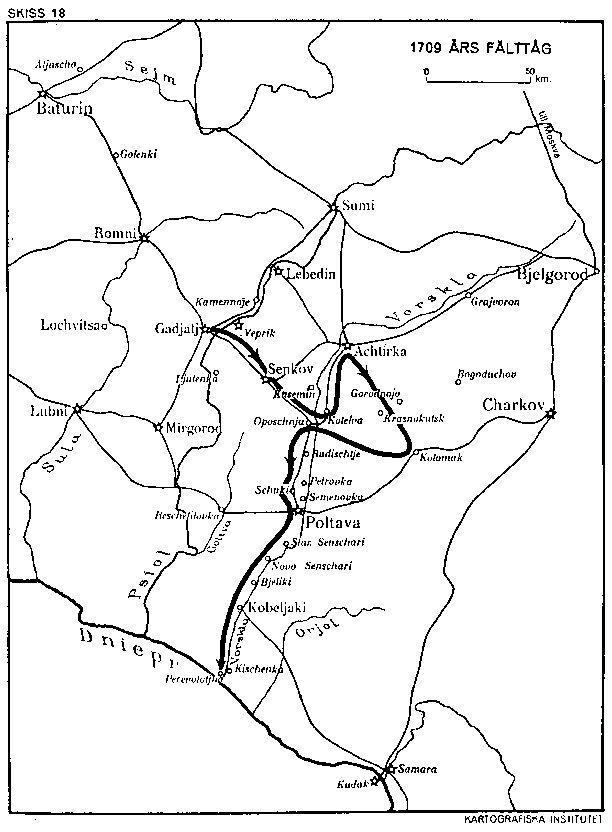
Instead of marching on Moscow, Charles turned west to deal with Augustus, whose Saxon and Polish territories he spent six years conquering. By the Treaty of Altranstadt (1706) he deposed Augustus from the Polish throne and imposed his own candidate, Stanislaus Leszczynski. The delay proved fatal. Peter rebuilt his army on the Swedish model, took Narva and Dorpat, founded St Petersburg on conquered Ingrian soil (1703), and drew Charles into a war of attrition. When Charles finally invaded Russia in 1708, allied with the Cossack hetman Mazepa, Peter denied him supplies, winter and Russian scorched-earth columns bled the march, and at Poltava on 8 July 1709 Peter destroyed the Swedish army outright. Charles fled into Ottoman exile at Bender, where he spent five years trying to draw the sultan into the war.
While Charles was away, the empire he had defended fell apart. Augustus returned to Poland; Denmark re-entered the war; Hanover, Prussia and Russia took the Swedish possessions in Germany and the Baltic; and Peter's new fleet defeated the Swedes at Gangut (1714). Charles returned to a ruined kingdom in 1715, defended Stralsund, and was killed by a shot through the head besieging Fredriksten in Norway in 1718. His sister Ulrika Eleonora and then her husband Frederick I made peace piecemeal: the Treaties of Stockholm (1719-1720) ceded Bremen-Verden to Hanover and part of Pomerania to Prussia, and the Treaty of Nystad (1721) ceded Livonia, Estonia, Ingria and eastern Karelia to Russia.
Nystad ended Sweden's age as a great power and confirmed Russia's arrival as one: Peter proclaimed himself emperor the same year, and St Petersburg became the new capital of a Russia that now dominated the Baltic and, increasingly, the politics of Poland, Germany and Scandinavia. The war also transformed both losers and winners: Sweden turned from absolutism to its parliamentary Age of Liberty, while Russia's victory rested on the forced Westernization, conscription, industry and a fleet built from nothing, that would define the empire for two centuries.
 World History Encyclopedia: Great Northern War
 Britannica: Charles XII