 Go Back

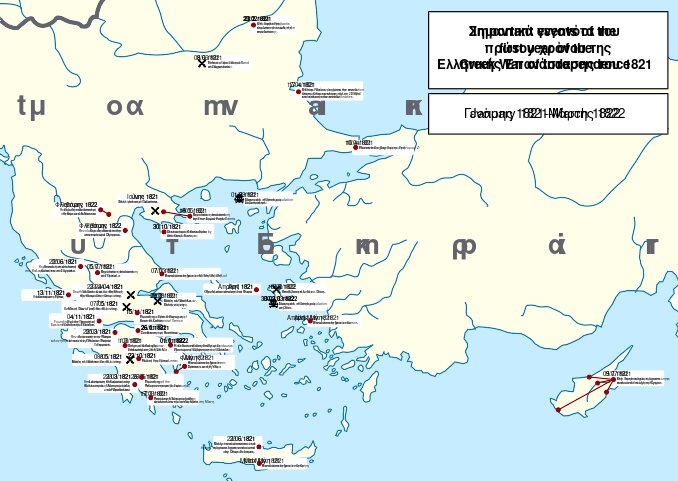
The Greek War of Independence (1821-1832) freed the first nation of the Ottoman Empire's European provinces and made Greece an independent kingdom. Its background was the national revival of the eighteenth century: the Greeks of the diaspora, of the Phanariot administration and of the merchant fleets, the ideas of the French Revolution, and the secret society Filiki Eteria, founded in Odessa in 1814, which organized the rising. In March 1821 Alexander Ypsilantis crossed into the Danubian Principalities hoping for Russian support, and was crushed; but in the Peloponnese the revolt proclaimed on 25 March spread like fire. By autumn the rebels held most of the peninsula: Tripolitsa fell in October 1821, amid massacres of its Muslim inhabitants that were answered by Ottoman reprisals, above all the execution of the Patriarch Gregory V in Constantinople and the massacres of Chios (1822), where tens of thousands were killed or enslaved.
The revolution nearly destroyed itself through civil war: rival governments, military chiefs and regional factions fought two civil wars in 1823-1825 even as they fought the sultan. Mahmud II called in his powerful vassal Muhammad Ali of Egypt, whose son Ibrahim Pasha landed with a modern army in 1825 and reconquered the Peloponnese systematically; Missolonghi, defended for a year, fell in April 1826, its garrison dying in a famous sortie that Byron's death there in 1824 had already made a European symbol. Athens fell in 1827, and the revolution survived only in a few pockets. Greece was saved by the powers: Britain, France and Russia, their publics ablaze with philhellenism, their cabinets pursuing advantage, mediated, and when negotiations failed their combined fleet destroyed the Ottoman-Egyptian fleet at Navarino (October 1827), the last great battle of the age of sail.
Russia's declaration of war (1828) and its victories on the Danube forced the sultan to terms. The Treaty of Adrianople (1829) gave Greece autonomy, and the London Protocol (1830), following the assassination of the first governor, the capable Ioannis Kapodistrias, made Greece an independent kingdom under the powers' guarantee. In 1832 the seventeen-year-old Bavarian prince Otto arrived as king with a Bavarian administration; his autocratic rule provoked a constitution in 1843, and the kingdom's borders, which excluded most Greeks, in Thessaly, Epirus, Macedonia, Crete and the islands, drove a century of irredentism under the 'Megali Idea'.
The Greek revolution's significance reached far beyond the Aegean. It was the first successful national revolution in Ottoman Europe, the model and the precedent for the Serbs, Romanians and Bulgarians who followed; it demonstrated that the Concert of Europe would not always defend the territorial status quo against national revolt; and the philhellenic movement, volunteers, loans, poems, made nationalism a European cause. Modern Greece, though small and repeatedly rescued, had shown that the empires of the old order could be broken.
 Britannica: War of Greek Independence
New World Encyclopedia: Greek War of Independence