 Go Back

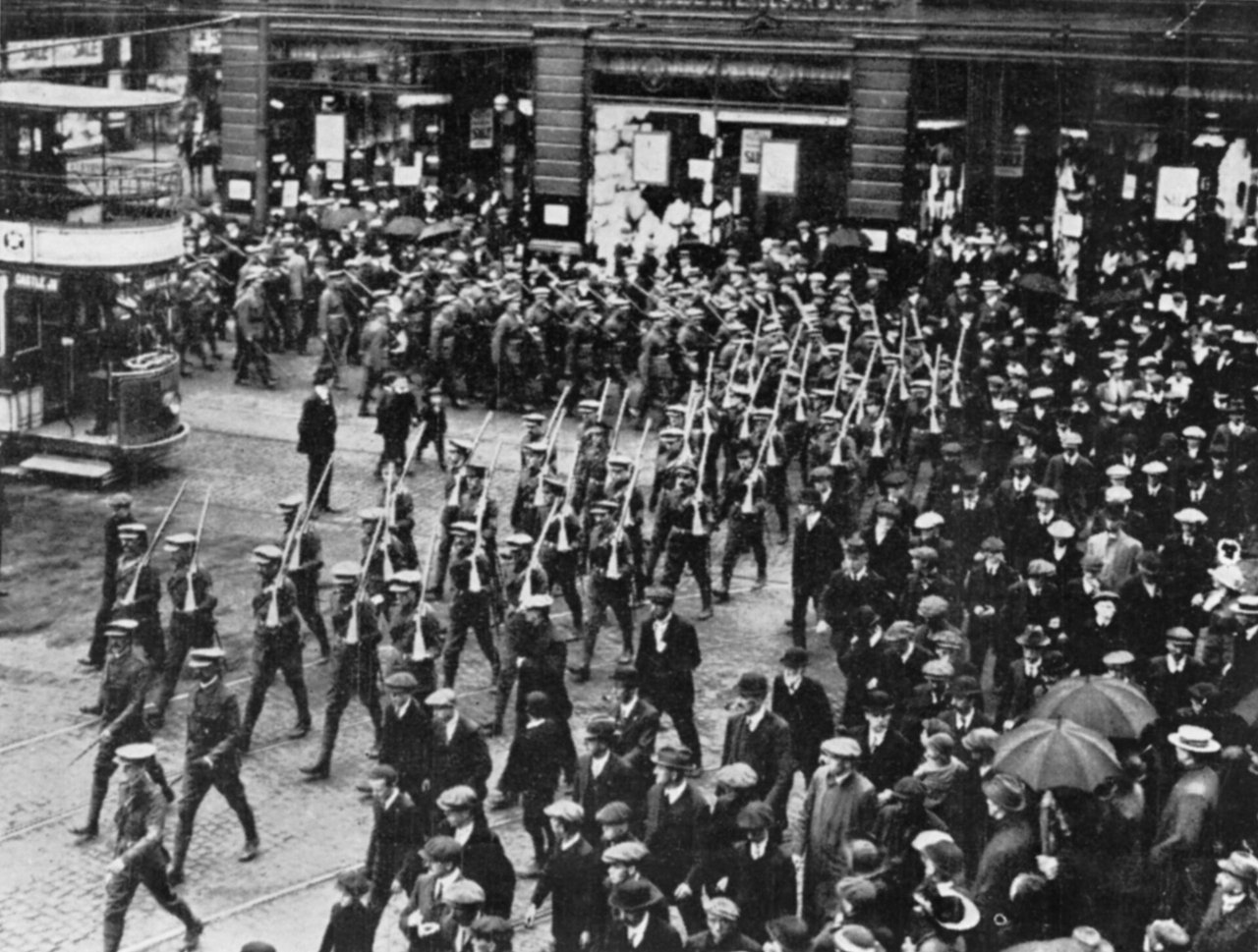
The Home Rule Crisis. Home Rule - an Irish parliament in Dublin for Irish affairs, within the United Kingdom - was the settled demand of constitutional nationalism from the 1870s, and twice it came within a breath of law. Gladstone's first bill fell in 1886, splitting his own party; his second passed the Commons in 1893 and was thrown out by the Lords. When the Parliament Act of 1911 broke the Lords' veto, a third Home Rule Bill was introduced in 1912, and this time nothing in the constitution could stop it. Ireland would have Home Rule by 1914 - unless someone stopped it by force.
Ulster's Protestants resolved to stop it by force. Home Rule, they held, meant Rome Rule: a Dublin parliament would be a Catholic parliament, and the Protestant, industrial, unionist northeast would be submerged in a Catholic, agrarian Ireland. In September 1912 nearly half a million men and women signed the Solemn League and Covenant, pledging to resist by all means; in 1913 they raised the Ulster Volunteer Force, one hundred thousand strong, and in April 1914 they landed twenty-five thousand German rifles at Larne. The nationalists answered with the Irish Volunteers and their own gun-running at Howth. Ireland stood on the edge of civil war, and the British army itself wavered - in the Curragh incident, officers refused to move against Ulster.
The question that could not be answered was Ulster itself: would the northeast be excluded from Home Rule, for six years or forever, four counties or nine? The Buckingham Palace Conference of July 1914 failed on exactly this point. Days later, Europe went to war, and Home Rule was enacted and suspended in the same breath, for the duration.
The suspension killed constitutional nationalism. The Irish Volunteers split; the republican wing, seeing its chance in England's difficulty, went on to the Easter Rising of 1916, and the Ulster Volunteers marched instead to the Somme, where the 36th (Ulster) Division was bled white on the first day. When the war ended, the Home Rule Ireland of 1912 was dead: the demand now was a republic, and Ulster's answer would be partition.
 Britannica: William Ewart Gladstone
Britannica: Ireland - The Act of Union
 Imperial War Museums: Ireland and the First World War