 Go Back

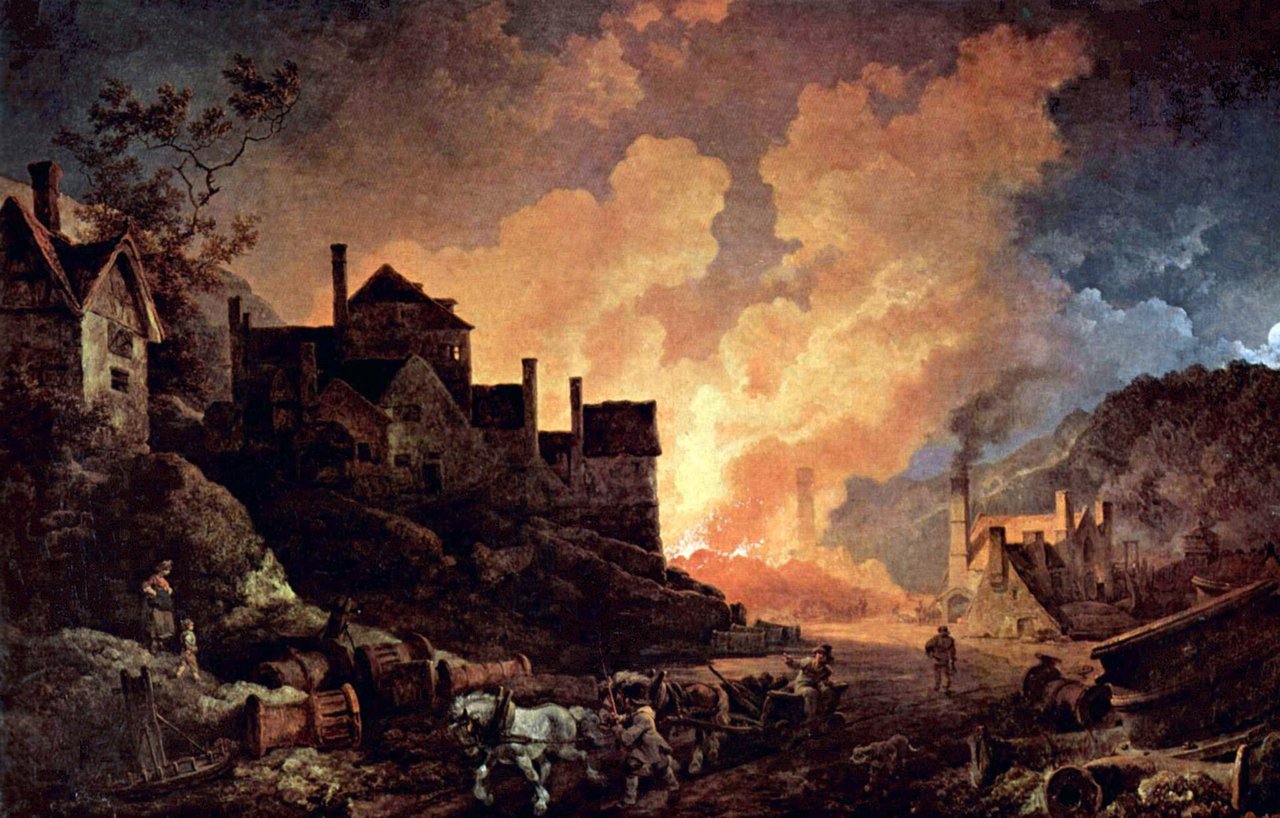
The Industrial Revolution. Between about 1760 and 1840, in a corner of an island off Europe, human beings escaped the oldest prison of their species: the limit of what muscle, wind and water could do. The Industrial Revolution began in Britain for reasons that converged nowhere else: cheap coal at the surface, high wages that made machines worth building, ironmasters and tinkerers in a tolerant scientific culture, an empire's markets, a navy to reach them, and a state that let inventors keep their profits.
It began in cotton. The flying shuttle, Hargreaves's spinning jenny, Arkwright's water frame, Crompton's mule - within a generation, the spinning and weaving of cotton moved from the cottage to the mill, and Manchester grew from a town into Cottonopolis, the first industrial city. Then came the master key: James Watt's improved steam engine, built with Matthew Boulton from 1776, which freed the factory from the riverbank and put rotary power anywhere coal could be carried. Coal, iron and steam became the trinity of the new economy; Abraham Darby's coke-smelted iron at Coalbrookdale built the world's first iron bridge in 1779.
The canals cut in the 1760s, then the macadam and Telford roads, and finally the railway - Stockton to Darlington in 1825, Liverpool to Manchester in 1830, where Stephenson's Rocket proved the locomotive - shrank the country and annihilated distance. By 1850 Britain produced half the world's iron and half its cotton cloth, carried most of its trade, and at the Great Exhibition of 1851, in Paxton's Crystal Palace, displayed itself without irony as the workshop of the world.
The human price was paid in the mill towns: children in the spinning rooms, the cholera cities Engels described, the ten-hour day fought for decade by decade. And yet the transformation was total and irreversible: by 1851 more Britons lived in towns than in the country - the first people in history to do so. What began in the Midlands valleys spread to Belgium, Germany, America and the world, and changed the conditions of ordinary life beyond anything conquest had ever done.
 Britannica: Industrial Revolution
Britannica: James Watt
 UNESCO: Ironbridge Gorge