 Go Back

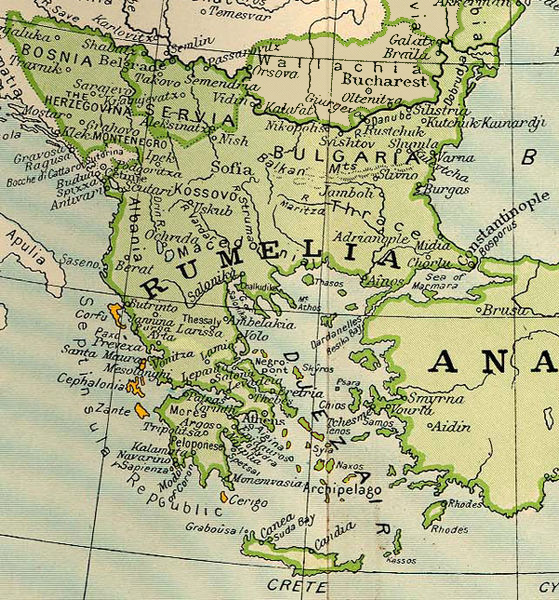
The Ottoman Balkans. The Ottomans entered Europe in the mid-14th century, seizing Gallipoli in 1354 after an earthquake emptied the city - their base for the conquest of the Balkans. Adrianople fell in 1369, Thessalonica in 1387; the Serbian-led resistance broke at Kosovo, where Sultan Murad I himself was killed; and in 1453 Mehmed the Conqueror took Constantinople, ending the Byzantine Empire. Ottoman Europe - 'Rumelia' - was born.
For two centuries the empire ruled the Balkans from the Danube to the Mediterranean: it fought Venice for four hundred years, suffering its great naval defeat at Lepanto in 1571 - then the largest naval battle in history - and its armies stood at the gates of Vienna. Only Corfu, of all the Greek islands, never fell to the Ottomans. The Balkan peoples - Greeks, Serbs, Bulgarians, Albanians, Romanians - lived under Ottoman rule for four or five centuries: Orthodox subjects of a Muslim sultan, their churches, languages, and memories preserved but their nations submerged.
The 19th century tore the fabric: the Serbian uprising of 1804-1817 won autonomy, the Greek Revolution of 1821-1832 won independence, and the Romanian war of 1877-1878 - fought alongside Russia - freed the Danubian principalities. The great powers, especially Russia, pressed the empire in war after war - the Holy League's Great Turkish War (1683-1699) had already begun reversing its gains - and the Balkan states pressed it from within.
The final retreat came in the Balkan Wars of 1912-1913, which drove the Ottomans almost out of Europe, and was sealed after the First World War by the Treaty of Sevres. Five centuries of Ottoman Europe ended; the borders, nations, and grievances it left behind still shape the Balkans today.
 Britannica: Balkans - Ottoman Empire, Southeastern Europe, Conflict
 The Metropolitan Museum of Art: Balkan Peninsula, 1400–1600 A.D.
 National Geographic: Why the Ottoman Empire rose and fell
 World History Encyclopedia: Ottoman Empire