 Go Back

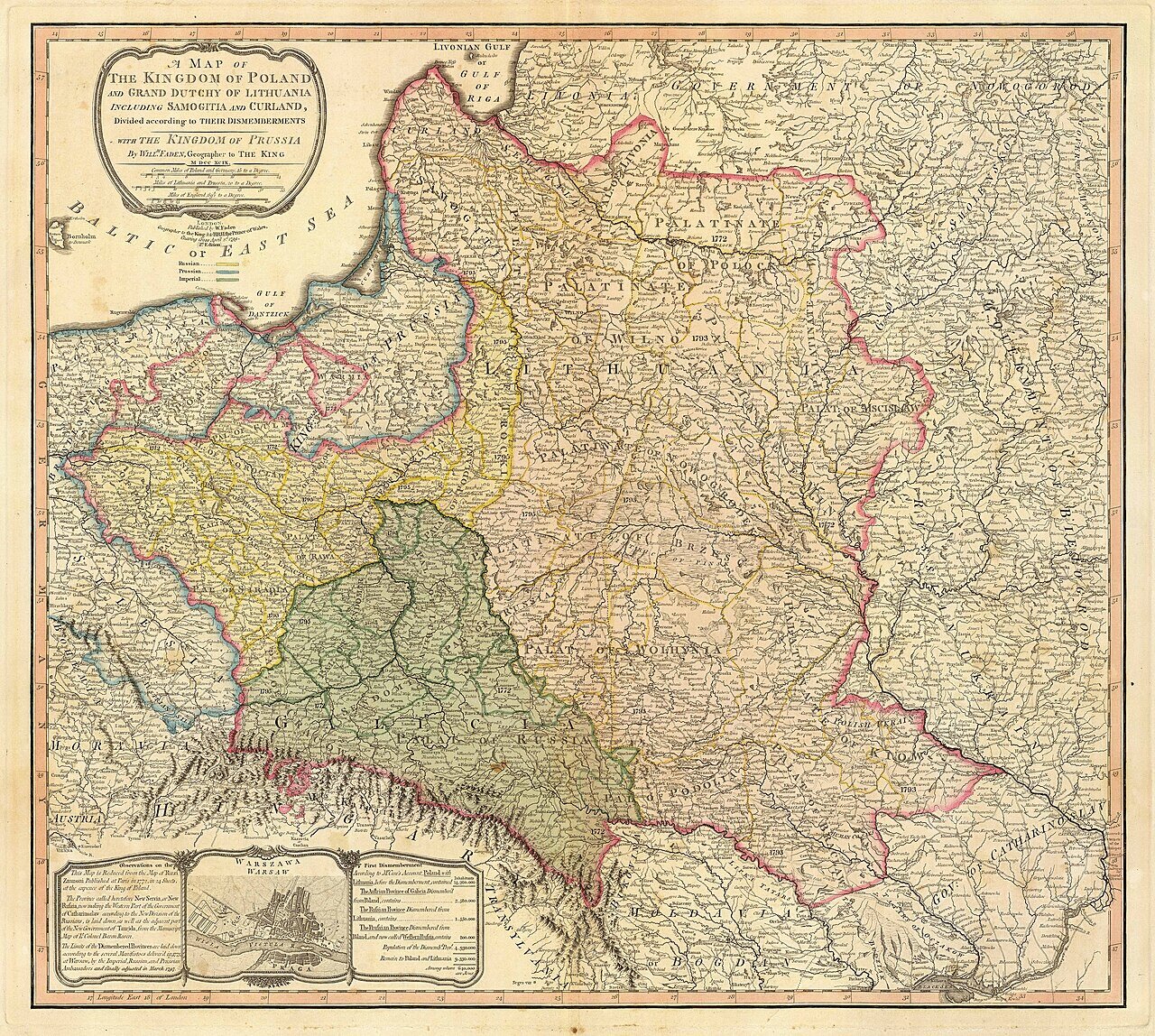
The Polish-Lithuanian Commonwealth and its Partitions. The Commonwealth was born on 1 July 1569, when the Union of Lublin fused Poland and Lithuania - joined in dynastic union since 1385 - into a single state with its capital first at Krakow, then from 1596 at Warsaw. When the childless Sigismund II Augustus died in 1572, the Jagiellonian dynasty ended, and the Commonwealth became an elective monarchy: nobles or foreign dynasts elected to the throne for life.
Its system - the Golden Liberty - was an early constitutional monarchy: the bicameral General Sejm held legislative power, the Henrician Articles bound the king, and the szlachta nobility, some 10 percent of the population, formed a kind of nobles' democracy. The Warsaw Confederation of 1573 guaranteed a religious tolerance remarkable for its age, and the Commonwealth's peoples - Poles, Lithuanians, Ruthenians, Germans, Jews - lived in unusual diversity.
Its first royal election, in 1573, saw some 40,000 nobles cast their votes - a 'nobles' democracy' without parallel in Europe. But the Golden Liberty hardened into paralysis: royal authority was bound ever tighter, the 17th century's wars devastated the state, and the great neighbors - Russia, Prussia, and Austria - learned to exploit its divisions. Under the last king, Stanislaw II August (1764-1795), the Commonwealth declined into a plaything of its neighbors.
The end came in three partitions: 1772, 1793, and 1795. In between, the Commonwealth attempted one of history's most remarkable last stands: the Constitution of 3 May 1791 - the first modern codified constitution in Europe, and the second in the world after the American - came too late to save it. Russia, Prussia, and Austria divided the country among themselves, and Poland-Lithuania vanished from the map for 123 years.
 Britannica: Commonwealth
 World History Encyclopedia: Why Poland-Lithuania Disappeared
 BBC: BBC Radio 4 - In Our Time, The Polish-Lithuanian Commonwealth
Britannica: Partitions of Poland