 Go Back

The Polish-Swedish Wars were a long series of conflicts between the Polish-Lithuanian Commonwealth and Sweden, fought above all for control of the Baltic coast between 1563 and 1721. Their roots were both commercial, the customs wealth of Riga and the Vistula grain trade, and dynastic: Sigismund III Vasa, elected king of Poland in 1587, was also the hereditary heir of Sweden, and when his uncle seized the Swedish throne as Charles IX in 1600 and deposed him, Sigismund refused to renounce his claim. The resulting wars began in Livonia, where Swedish and Commonwealth armies fought over Estonia and Latvia through the 1620s: Gustavus Adolphus took Riga (1621) and most of Livonia, and from 1626 carried the war into Royal Prussia, where the Poles under Stanislaw Koniecpolski held him in check for three years.
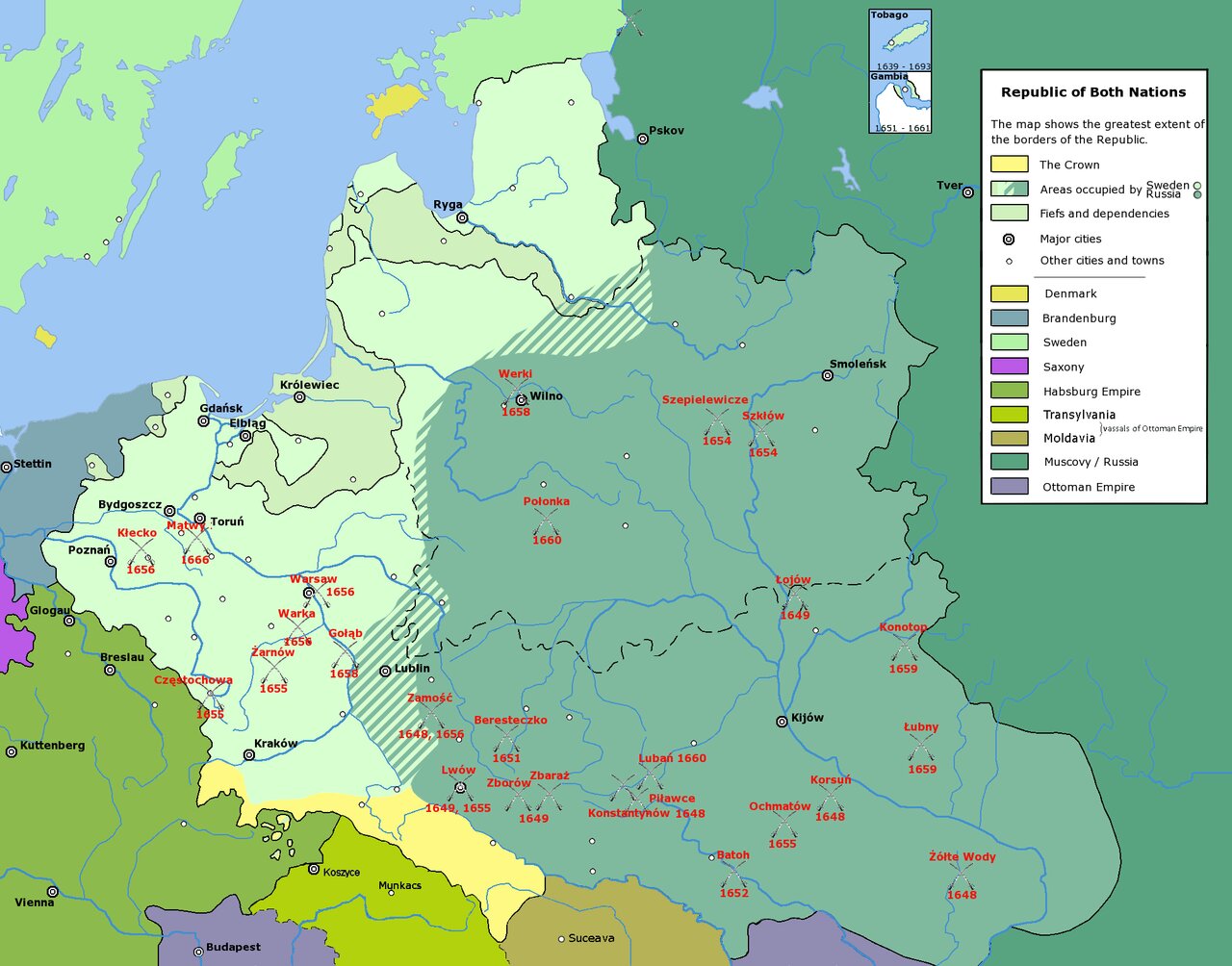
The truces that punctuated the fighting masked Sweden's gradual gain: by the Altmark Truce (1629) Sweden kept Livonia and the right to toll the Vistula ports, financing the army that Gustavus then led into Germany. The Commonwealth's eastern wars, against Cossacks, Russia and the Ottomans, gave Sweden its great opportunity. In 1655, while Poland reeled from the Khmelnytsky Uprising and the Russian invasion, Charles X Gustav attacked, and the Commonwealth nearly died: in the 'Deluge', the Swedish army overran and occupied most of the country by October 1655, and King John Casimir fled abroad. The occupation collapsed as Polish peasants and gentry rose against Swedish control, the defense of the Jasna Gora monastery at Czestochowa became the national legend, and by 1660 the Peace of Oliva ended the Deluge with Poland's sovereignty intact but exhausted.
The last round came in the Great Northern War, when Augustus II the Strong, elector of Saxony and king of Poland, joined Russia and Denmark against Charles XII. The war devastated the Commonwealth: Charles deposed Augustus, imposed Stanislaus Leszczynski (1704), and used Poland as his base for the Russian campaign that ended at Poltava (1709). Augustus returned, but the Commonwealth had become a theater for other powers' armies and a protectorate of Russia, which guaranteed its 'Golden Liberty' constitution precisely because that constitution made the state ungovernable.
The long wars with Sweden cost the Commonwealth its Baltic provinces, its best trade ports and, ultimately, its position as a great power: by 1721 Poland was financially broken, its army tiny, its liberum veto paralyzing reform, while Sweden too had spent its empire in the struggle. Both Baltic powers were eclipsed by Russia and Prussia, and when Poland was partitioned by its neighbors (1772-1795), Swedish interference was among the fatal weaknesses the partitioners exploited.
 Encyclopedia.com: Northern Wars
 Britannica: Sigismund III Vasa
Encyclopedia.com: Gustavus II Adolphus
Britannica: First Northern War
Britannica: John II Casimir Vasa
Encyclopedia.com: Peace of Oliva