 Go Back

The Russo-Turkish Wars were the long series of conflicts, twelve major wars between 1568 and 1917, through which Russia expanded southward at the Ottoman Empire's expense. The early clashes were frontier wars over the steppe: Astrakhan, the Azov fortress, and the Crimean Khanate, the Ottomans' vassal, whose slave-raiding horsemen burned Moscow itself in 1571. Peter the Great took Azov (1696), lost it again on the Pruth (1711), and the eighteenth century turned the wars into a systematic Russian advance: by the Treaty of Kucuk Kaynarca (1774), after Catherine the Great's armies won at Kagul, Russia gained a foothold on the Black Sea, the right to navigate it, and a claimed protectorate over Ottoman Orthodox Christians. Nine years later Catherine annexed Crimea outright.
The nineteenth century made the wars the core of the 'Eastern Question'. Russia presented itself as the protector of the sultan's Orthodox subjects, Greeks, Serbs, Romanians, Bulgarians, while Britain and France feared the Straits falling into Russian hands and repeatedly propped the Ottoman Empire up. The wars of 1806-1812 and 1828-1829 gave Russia Bessarabia and the Danube's mouth and helped free Greece; the war of 1853-1856, the Crimean War, was Russia's great reversal, when Britain, France and Sardinia intervened to save the sultan and neutralized the Black Sea. Russia answered with expansion in the Caucasus and Central Asia, and with pan-Slav support for the Balkan Christians.
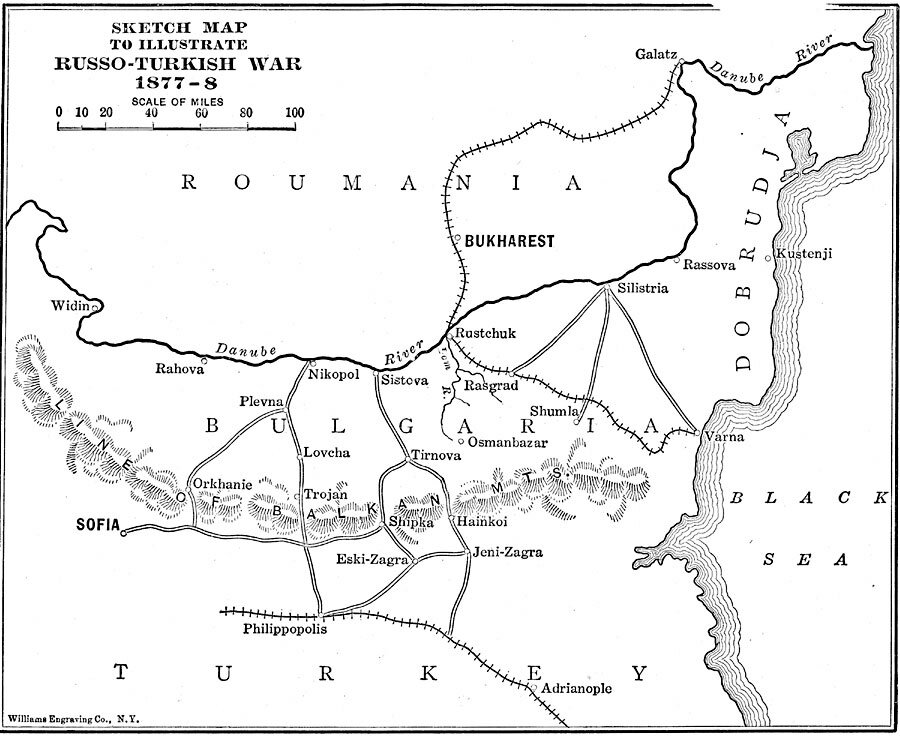
The great war came in 1877. After the Ottomans crushed Bulgarian and Serbian risings with massacres that outraged Europe, Alexander II declared war. Russian armies crossed the Danube, were held for months at Plevna by Osman Pasha's heroic defense, then broke through the Balkan mountains in winter to within reach of Constantinople. The Treaty of San Stefano (March 1878) created a huge autonomous Bulgaria and recognized the independence of Serbia, Montenegro and Romania; but the powers refused a Russian-made Balkans, and the Congress of Berlin, Bismarck as 'honest broker', cut Bulgaria in three, returned Macedonia to the sultan, gave Bosnia to Austria-Hungary's administration, and Cyprus to Britain. Russia had won the war and lost much of the peace.
The wars' legacy was the modern Balkans and Russia's Black Sea position: Romania, Serbia, Montenegro and Bulgaria owed their independence substantially to Russian arms, while the Caucasus, Armenia's eastern lands and the fortress of Kars passed to the tsars. The two empires fought once more in the First World War, the disasters of Sarikamish and the Russian occupation of Erzurum and Trebizond, before both collapsed into revolution in 1917. Successor states kept the rivalry alive: Soviet and then Russian power against a Turkey anchored in NATO, contesting the Straits, the Black Sea and the Caucasus to the present day.
 Britannica: Russo-Turkish wars
 World History Encyclopedia: Ottoman Empire