 Go Back

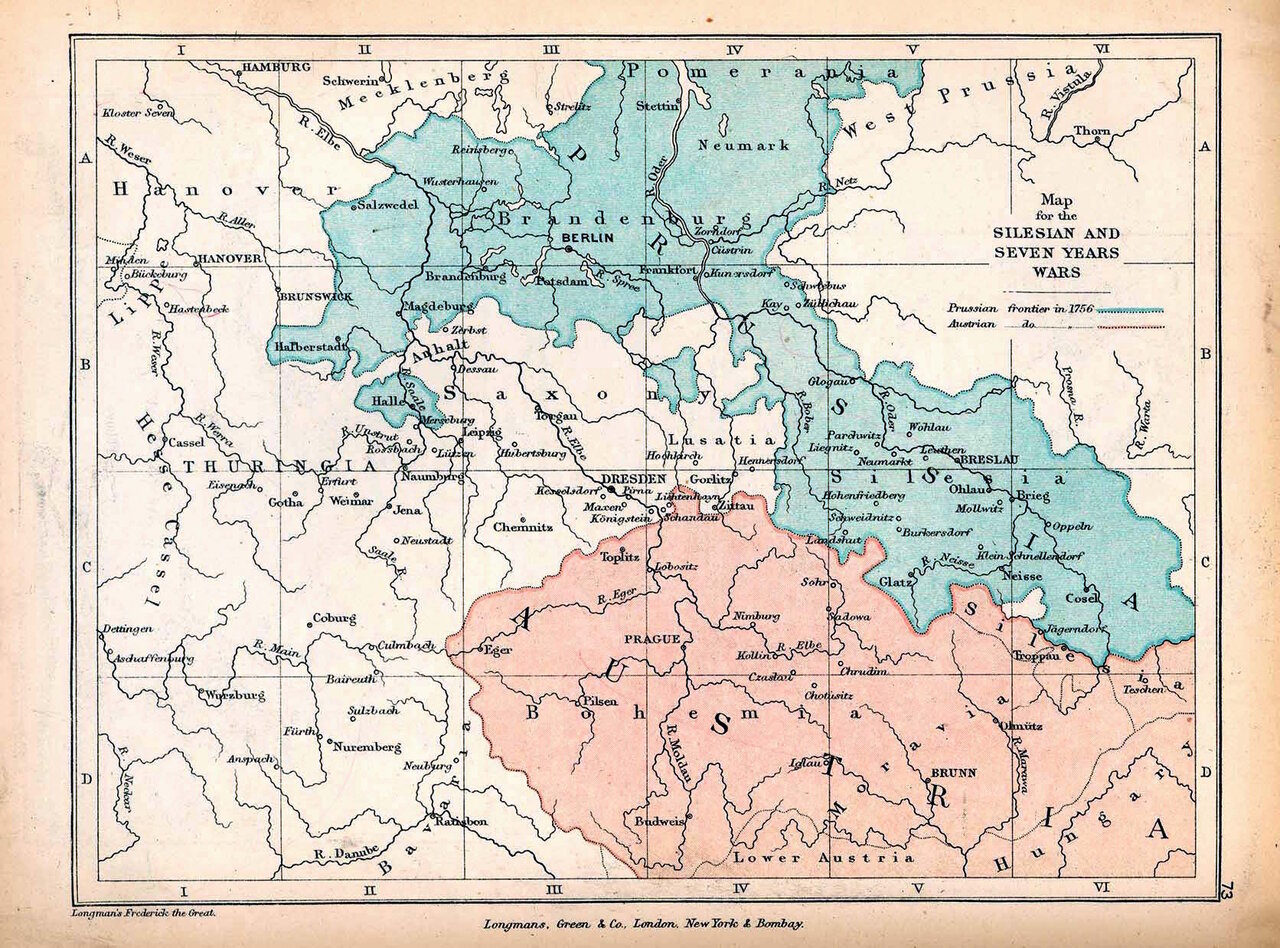
The Seven Years' War (1756-1763) was the first truly global war, fought in Europe, North America, India, the Caribbean and the Pacific. Its immediate cause in Europe was the 'diplomatic revolution' of 1756: centuries of Franco-Habsburg rivalry ended in an alliance between Austria and France, joined by Russia, to crush Prussia, whose king Frederick II had seized Silesia from Maria Theresa of Austria in 1740. Britain aligned with Prussia, subsidizing Frederick while fighting France for empire overseas. Frederick struck first, invading Saxony in 1756 to forestall the coalition against him.
Frederick's Prussia survived by generalship against encircling enemies four times its size. In 1757 he destroyed a French and imperial army at Rossbach in under an hour and a month later routed the Austrians at Leuthen; but the Russians won at Gross-Jagersdorf and Kunersdorf (1759), where the Prussian army was annihilated and Frederick contemplated suicide, and Austrian and Russian armies briefly occupied Berlin (1760). The 'miracle of the House of Brandenburg' came in 1762 when the pro-Prussian Peter III succeeded Elizabeth in Russia, made peace, and even returned conquests; Sweden then dropped out, and Austria, bankrupted, made peace at Hubertusburg (1763), restoring the status quo: Prussia kept Silesia and emerged confirmed as a great power.
In North America, where the war had effectively begun in 1754 with skirmishes in the Ohio valley, France initially prevailed, but British money, sea power and colonial manpower turned the tide: Louisbourg fell in 1758, and in 1759 Wolfe defeated Montcalm on the Plains of Abraham outside Quebec, both generals dying, and Montreal surrendered in 1760, ending New France. In India, Robert Clive's victory at Plassey (1757) made the East India Company master of Bengal, and Pondicherry fell in 1761. Spain, entering late on France's side, lost Havana and Manila to British expeditions in 1762.
The Peace of Paris (1763) redrew the world map: France ceded Canada and all territory east of the Mississippi to Britain and Louisiana to Spain, and left India reduced to a few trading posts; Spain ceded Florida and received Louisiana and Havana back. Britain became the dominant colonial and naval power, and the costs of victory, taxing the American colonies to pay the war's debt, set in train the crisis that produced the American Revolution a decade later. In Europe the war confirmed Prussia's survival and Russia's arrival as a decisive player, and it left Austria and France nursing debts and grievances that would surface again in the revolutionary era.
 Britannica: Seven Years' War
 World History Encyclopedia: Seven Years' War