 Go Back

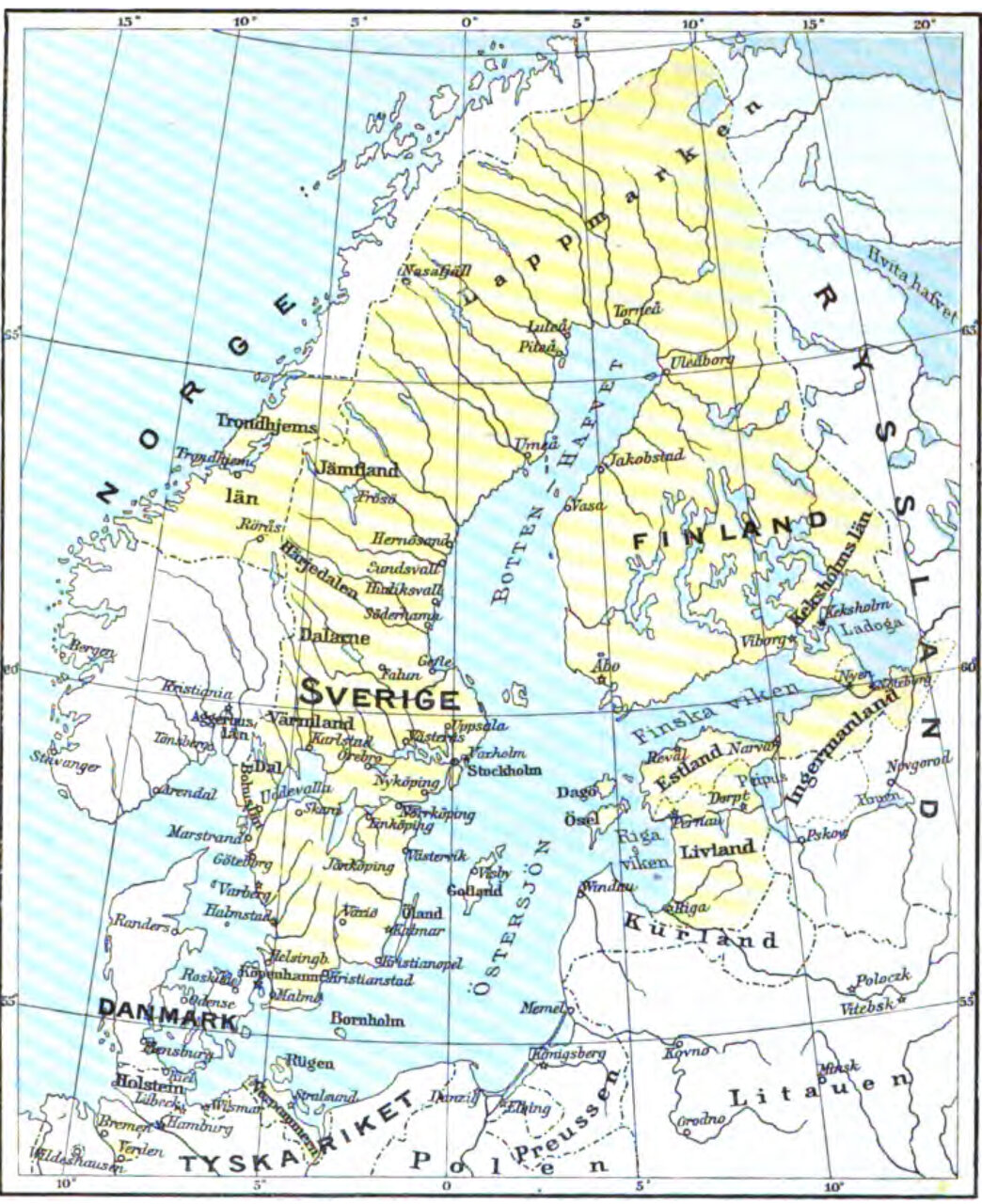
The Swedish Empire, the stormaktstiden or 'age of great power', made Sweden the dominant power of the Baltic in the seventeenth century. Its foundations were laid under Gustavus Vasa, who broke the Kalmar Union in 1523, seized church wealth in the Reformation, and built a centralized monarchy, and by the conquests of his grandsons in the eastern Baltic. The empire proper began with Gustavus Adolphus (1611-1632): reformed army, national conscription, mobile artillery, and battlefield drill made Sweden's army the most modern in Europe. His intervention in the Thirty Years' War, from the victory of Breitenfeld (1631) to his death at Lutzen (1632), made Sweden the arbiter of Germany.
The Peace of Westphalia (1648) rewarded Sweden with western Pomerania, Bremen-Verden and Wismar, giving it control of the mouths of the Oder, Elbe and Weser. Under Charles X Gustav, Sweden seized Scania, Halland and Blekinge from Denmark (Treaty of Roskilde, 1658), closing the Danish strait empire, and under Charles XI the realm was consolidated: the reduction of 1680 expropriated the great nobles' crown lands, financing a standing army and the allotment system, indelningsverket, that quartered soldiers on farms. The Baltic had become a Swedish lake, and the empire stretched from Norway to Estonia and Ingria.
Charles XI's son Charles XII inherited the empire in 1697 at fifteen, and the neighbors he had humbled, Denmark, Saxony-Poland and Peter the Great's Russia, attacked in 1700 to recover their losses. The young king's response was astonishing: he knocked Denmark out at once, annihilated a far larger Russian army at Narva (1700), then spent six years conquering Poland and Saxony, deposing Augustus the Strong. But in 1709, deep in Ukraine, his army was destroyed at Poltava, and the empire collapsed around him: Russia occupied the Baltic provinces, Hanover and Prussia took the German lands, and Charles, returning from Turkish exile, was killed besieging Fredriksten in 1718. The treaties of Stockholm and Nystad (1720-1721) stripped Sweden of everything except Finland and part of Pomerania.
The empire's fall made Sweden a minor power and Russia the new master of the Baltic. At home, the death of Charles XII ended royal absolutism and opened the Age of Liberty (1719-1772), a remarkable experiment in parliamentary party government under the Hats and Caps, ended by Gustav III's coup. Sweden lost Finland to Russia in 1809, gained Norway in compensation in 1814, and, under Bernadotte, adopted the neutrality it has largely kept since. The stormaktstiden remained Sweden's national myth: proof that a poor country of barely a million people could, by military organization and state discipline, briefly rule an empire.
 Britannica: Sweden
Britannica: Gustavus Adolphus