 Go Back

Tudor England. The Tudors were an accident of war. Henry Tudor, Earl of Richmond, had a distant claim to the throne and a small army of French mercenaries when he landed in Wales in 1485; at Bosworth Field he killed Richard III and took the crown as Henry VII, ending the Wars of the Roses. The new dynasty was illegitimate in half the kingdom's eyes, and Henry VII spent his reign making it safe: marrying Elizabeth of York to join the warring roses, hunting down pretenders like Lambert Simnel and Perkin Warbeck, and filling his treasury by extortionate but peaceable government. He left his son a full exchequer and an unchallenged crown.
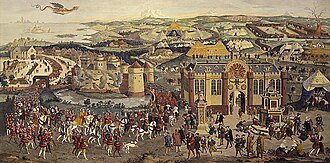
Henry VIII inherited in 1509: young, rich, magnificent, and determined to cut a figure in Europe. For twenty years his reign was governed by Cardinal Wolsey and remembered for pageantry - the Field of the Cloth of Gold - and for the burning question that consumed it: the King's Great Matter, his demand to annul his marriage to Catherine of Aragon, who had given him a daughter, Mary, but no living son. When the Pope refused, Henry broke with Rome.
The English Reformation was made by statute, in a single revolutionary decade. Between 1532 and 1534 Henry's Parliament cut every tie to Rome and declared the king Supreme Head of the Church of England; Thomas More and John Fisher died on the scaffold rather than swear it. Thomas Cromwell then engineered the dissolution of the monasteries - eight hundred religious houses closed, their lands sold to the gentry, their shrines stripped - a transfer of a fifth of England's land and a blow from which the old church never recovered. Henry married six wives in all, executed two of them, and fathered the three children who would rule after him.
The break with Rome was Henry's, but its consequences ran far beyond him: England was launched on its path as a Protestant power, its navy - Henry's own creation, with its great ships and dockyards - was the seed of sea power, and the crown stood stronger than ever. When Henry died in 1547, the England of his children's reigns - Edward's zealous Protestantism, Mary's fires, Elizabeth's long settlement - had been set on its course by his monumental self-will.
 Britannica: Henry VIII
Britannica: Church of England
Britannica: Battle of Bosworth Field